
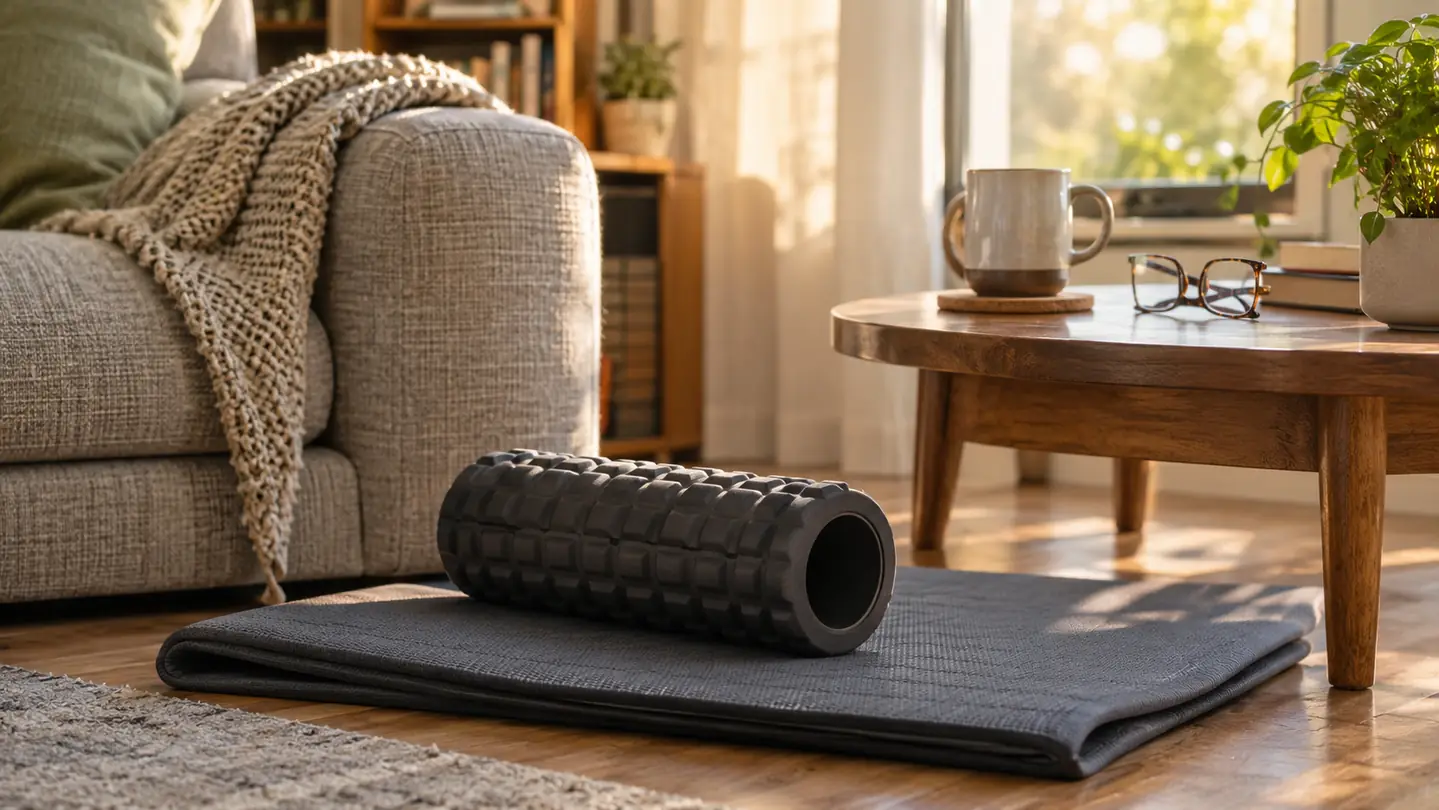
Nobody tells you that the first week with a foam roller is mostly a negotiation over how much discomfort you are willing to trade for relief. I bought the TriggerPoint Grid in May 2025 after my physical therapist put one under my calf in her office and told me to give it a try. I was 63 then, retired after 31 years running a school cafeteria, with osteoarthritis in my right knee since I was 59 and a lower back that stiffens up after a morning in the garden. Eighteen months later the roller lives on the floor beside the couch, and I have opinions the listing does not hand you.
So this is the honest version. Not whether the TriggerPoint Grid is a good foam roller, because it is, but whether it suits a person whose knees complain on the stairs and whose back aches every morning. There are things I wish someone had said to me before I clicked buy, and a few people I would tell to walk right past it.
The Quick Verdict
Extra firm and genuinely useful on calves, outer hips and upper back, but the short 13 inch length and the hard surface make it a rough first roller for anyone nervous about their knees or getting down onto a floor.
Amazon Check Today's Price →The Roller My Physical Therapist Handed Me, Not the One I Would Have Picked Myself
Extra firm, ridged in three dimensions, and about the size of a folded newspaper. Look hard at the length and the firmness line before you decide it suits you.
Amazon Check Today's Price on Amazon →The Firmness Is the Whole Story, and the Listing Buries It
The attributes call it extra firm, and extra firm is the accurate description. The surface is a three dimensional grid of ridges and raised nodules, and the density shifts across that pattern, so some sections press harder than others. That is the entire design intent and it is also the thing that catches people out. If you have only ever leaned on a smooth, forgiving roller at a gym, this will feel like a different category of object altogether.
My first attempt was on the outside of my right thigh, and I lasted about forty seconds. It was not pain exactly. It was the sensation of something pushing back and refusing to give. My therapist had warned me to go slowly and keep breathing, so I did, and by the end of the second week I could stay on that spot for a couple of minutes without bracing my whole body against it.
The second night I made a worse mistake and ran the TriggerPoint Grid straight up the middle of my lower back, which is exactly where my therapist had told me not to go. It took about ten seconds to understand why. The ridges found the spot that had been stiff since the fall garden cleanup and pressed into it like a thumb, and the whole area clenched in protest. I rolled off, sat on the mat, and gave myself a talking to. The upper back and the hips, that is where this roller belongs on a person my age. The lumbar area gets heat and gentle movement and nothing harder than a flat hand.
Where the firmness earns its keep is on the stubborn spots. The sides of my hips and the outer thigh respond to pressure that a soft roller simply glides over without doing much. My calves, which tighten up from the one mile loop I walk most mornings with my neighbor Ruth, take the ridges well once you get used to them. Where it does not earn its keep is anywhere bony or delicate. I would not put it near a knee joint. Mine stays on muscle, never on the joint itself, and that was my therapist's rule before it was mine.
How I Actually Use It, Eighteen Months In
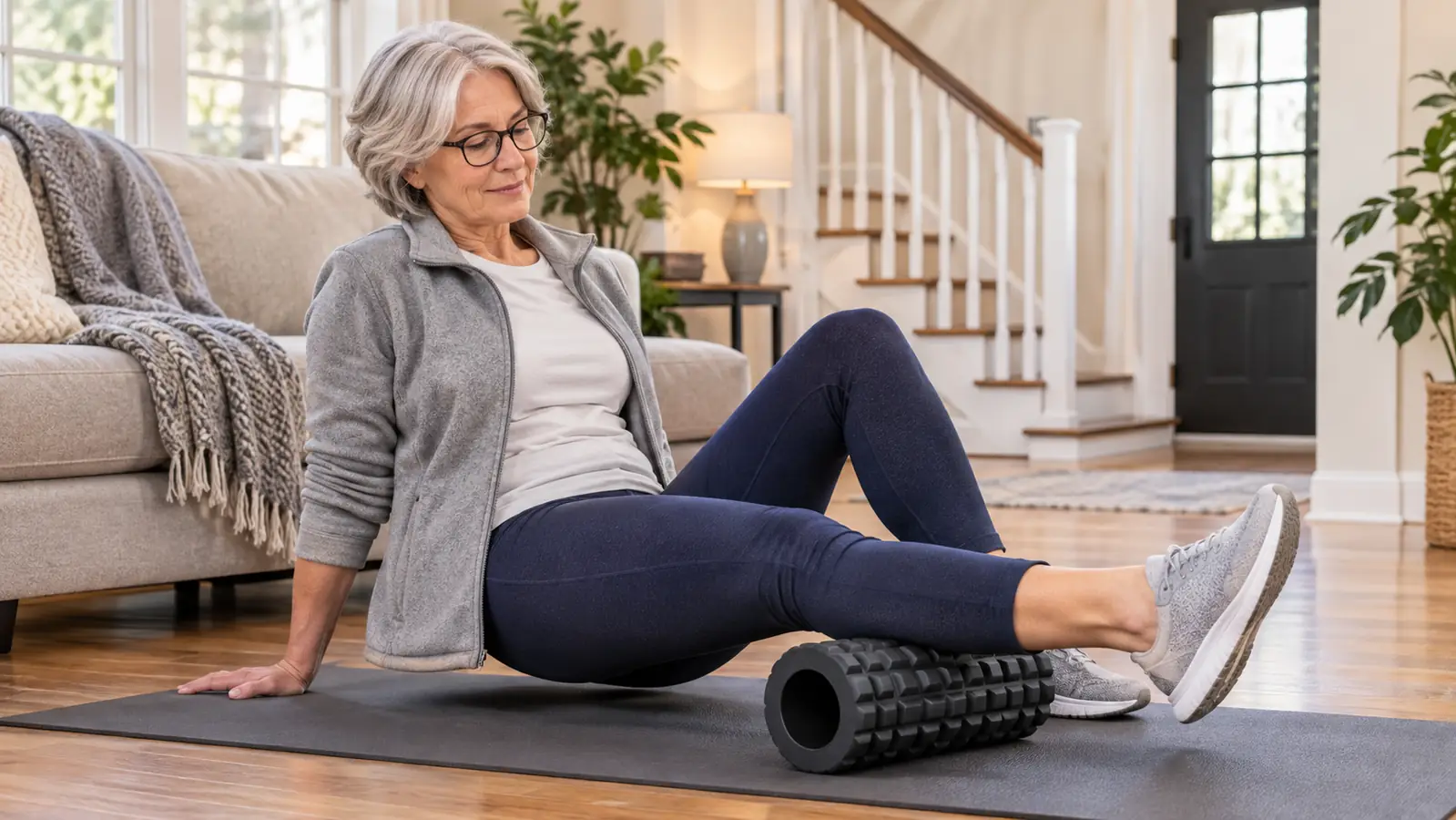
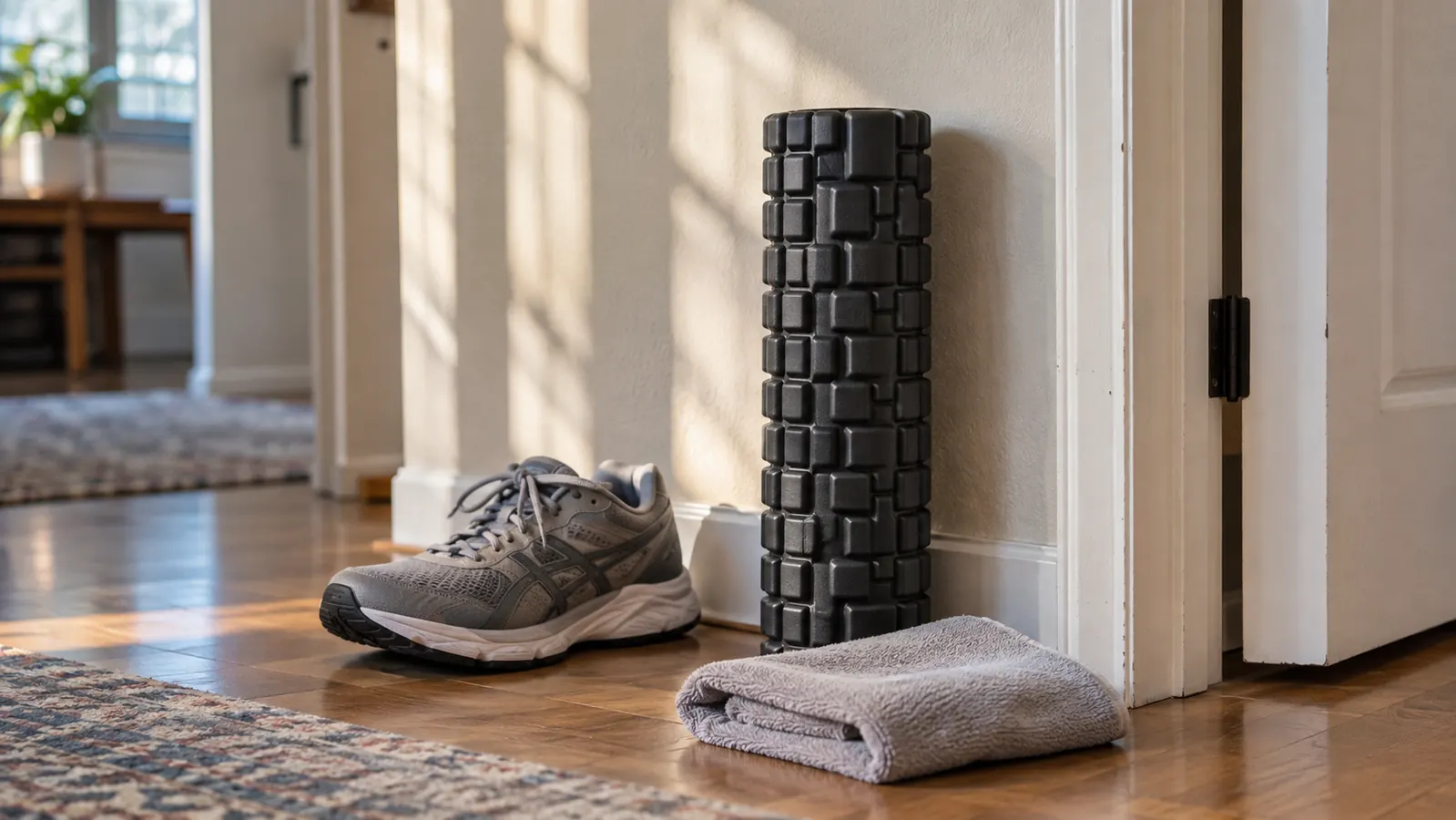
Two positions, that is the whole routine. Standing, I wedge the roller against the hallway wall and lean my upper back and the sides of my hips into it, moving slowly up and down. Sitting, I am on a yoga mat on the living-room floor with my calf or the back of a thigh on top of the roller, hands behind me for support. The arm of the couch is my handrail for getting back up, and I am not the least bit embarrassed about that.
The standing version is what I would recommend first to anyone with balance concerns, and I mean that sincerely. Both feet stay flat on the floor and the wall does the work. The floor version asks more of you, and the honest part nobody puts on a product page is that getting down is easy while getting up is the hard bit.
On a normal evening it runs like this. I finish the supper dishes, put the kettle on for tea, and lay the mat out while it boils. Wall first, because the hallway is right there, upper back for about a minute and then each hip for thirty seconds or so. Then down onto the mat for the calves, one leg at a time, and the backs of the thighs if the walk that morning was a long one. Gus steps around me on his way to the recliner and has stopped asking what I am doing, which took him about four months.
A few minutes on most evenings, and then I stop. Not twenty minutes. Not a session with a program and a timer. I do the calves, the backs of the thighs, the outer hips and the upper back, and I put it away. The rule my therapist left me with was simple: if it makes you clench, you are pressing too hard, and pressing harder is not how you get more out of it.
Getting Down Onto the Floor Is the Real Test
If you have a sore knee, plan the floor work before you are sitting on the mat wondering how to stand up. I worked this out the awkward way in the first week, when I rolled both calves and then sat there for a minute working out my exit. Now the couch arm is part of the setup, not an afterthought. I roll toward the couch, not away from it.
There is also a dignity question that nobody writes about. Getting up off a living-room floor at 64 with an arthritic right knee is not elegant. If you are the sort of person who will quietly skip the whole thing because the getting up part is a nuisance, then be honest with yourself about that now and either set up a proper handhold or stick to the wall version. The wall version is not the lesser version. It is just the one you will actually do on a Tuesday.
What Surprised Me
The first surprise is that the part I noticed most was not my knee at all. It was my upper back, between the shoulder blades, which I had never thought of as a problem area until the first week I rolled it. Thirty one years of lifting stock pots and milk crates had pulled me forward, and the ridges found sore spots I did not know were there.
The second surprise is that a few minutes genuinely is enough. I had assumed you needed a long routine to get anything out of a roller. What I found is closer to loosening a knot than doing a workout, and small doses on most evenings beat one long session on a Sunday afternoon.
The third is that it replaced nothing. I still do the home exercises I was given during those six weeks of physical therapy back in spring 2025. I still lie the heating pad across my lower back most mornings before my walk. The roller is one more item in a rotation, not the answer to the whole problem, and anyone selling it as the answer is selling you something else.
The Size Is Smaller Than You Think
Thirteen inches. The listing states it plainly and I still did not picture it correctly before it arrived. It weighs about a pound, and it stores in a corner or beside a couch without anyone tripping over it, which in a two-story house with a narrow hallway matters more than I expected.
It is a limitation the moment you want to lie across it. On a longer roller you can put both calves down at once and rock. At 13 inches you are working one leg at a time and there is not much room to travel up and down your back. I do not mind, because one leg at a time is what my therapist wanted anyway, but if you pictured yourself lying lengthwise with your whole spine on the thing, this is not that roller.
I tested the length question properly in the summer, when I tried to lie along it with my whole spine and rock gently from the shoulder blades down. At 13 inches my head hung off one end and my tailbone off the other, and the whole thing rolled sideways under me within a few seconds. I tried it once more a week later and got the same result. That is not a fault exactly, it is just what a short roller does, and it is worth knowing before you order in case a long one is what you had in mind.
One thing that confuses people is the dimension line, which reads 3.94 by 5.12 by 5.12 inches, while the diameter line says 13 inches. Think of it as 13 inches long and about five inches across and you will have the right mental picture before you order.
What I Liked
- Extra firm density that reaches the outer hips and thighs a soft roller slides straight over
- The raised grid pattern finds tight spots in the upper back without any real technique on your part
- 13 inches and about a pound, so it lives beside the couch and travels in a tote bag
- Held up through 18 months of near-daily use with no flattening or crumbling at the surface
- Works standing against a wall, which keeps both feet on the floor
Where It Falls Short
- Extra firm means a genuinely rough first fortnight if you have never rolled before
- 13 inches is short for lying lengthwise along the spine or working both calves together
- Nothing on the listing warns a beginner how hard the surface actually is
- The ridges are unforgiving on bony areas, and it should be kept off the joint itself
- Getting down onto a mat and back up is the real barrier, and it is not mentioned anywhere
Forty seconds on the outside of my thigh the first night. Two minutes without bracing by the end of the second week. It gets easier, but not because the roller softens.
What It Does Not Do
It does not fix a knee with osteoarthritis. Nothing does, and I would be suspicious of anyone who tells you otherwise. What it does, on a good week, is make the muscles around that joint less angry, which makes the stairs feel less like a negotiation. That is a real difference on a Tuesday morning. It is not a cure, and my doctor has never once suggested it was.
It also does not help a back that is already locked up. On the mornings my lower back seizes, rolling is the last thing I want. Heat first, then gentle movement, then the walk with Ruth. The roller comes later in the day if it comes at all, and it stays off the lower spine entirely. I do the upper back and the hips and leave the lumbar area alone.
October was the test of that. I spent a Saturday afternoon cutting back the tomato vines and hauling the spent plants out to the curb, and by five o'clock my lower back had that hot, tight feeling that means I overdid it. Rolling was not on the table that evening. What I did instead was twenty minutes with the heating pad in the recliner, then a short walk to the corner and back with Ruth the next morning instead of the full loop, and the roller only on the Sunday evening, gently, on the sides of my hips. It helped at the edges. It did not undo the Saturday.
And it does not cover for the exercises. I know that sounds like something a clinic would print on a poster, but I tested it by accident. There was a stretch last winter, around the holidays, when I rolled most evenings and skipped the exercises because the grandchildren were visiting and the days got away from me. The roller did not pick up the slack. My knee let me know about it by the middle of January.
What Eighteen Months Has Done to It
Nothing dramatic, and that is a compliment. The surface has not flattened, the pattern of ridges is still pronounced, and there is no crumbling or shedding at the edges despite it living on a floor and being used most evenings. I wipe it down with a damp cloth every couple of weeks and that is the whole of the maintenance.
The one change is on my side, not the roller's. I use it more gently now than I did at six months, and for shorter stretches. The early enthusiasm where I rolled everything for ten minutes has settled into a habit of three or four targeted minutes. That is probably the better way to use it, and I had to arrive at it myself because nothing in the packaging tells you that.
If You Are Buying One for Someone Else
A good number of people reading this are the grown children, and I would say two things to you. First, ask about balance and about getting down onto a floor and back up, because that is the actual barrier here, not the cost. Second, the extra firm surface is a poor first roller for a nervous beginner. If your parent has never used one, a softer roller to start and this one later is the kinder path.
If they are already active, already doing their exercises, already walking most mornings, then this is a sensible gift. My own daughter asked what I wanted that year and I told her nothing, which is what I always say, and then I went and bought this myself. She would have chosen better than I did.
Who This Is For
This suits the person who has already been shown how to roll, or is willing to be shown by a physical therapist. Someone with tight calves, tight outer hips and a stiff upper back, who has enough knee stability to get down onto a mat and back up again, or who is content to work standing at a wall. Someone who will use it for three minutes rather than thirty, and who is not looking for a cure, just a way to feel less rusty by the evening.
Who Should Skip It
Skip it if your balance is uncertain and there is nobody around to spot you on the floor, or if you have never rolled and have nobody to show you the positions. Skip it if the joint itself is the whole problem and the muscles around it are not especially tight, because a roller does very little for a joint. And skip it if what you actually want is a soft, forgiving first roller to build the habit on, because the TriggerPoint Grid is not that, and it never pretends to be.
Three Minutes Most Evenings, Not a Cure and Not a Gimmick
Extra firm, 13 inches across the long side, and the one that was put under my calf in a physical therapy office. Read the firmness line and the size line twice before you decide.
Amazon Check Today's Price on Amazon →