

I did not go shopping for a foam roller. A physical therapist handed me hers during a session in the spring of 2025 and said, try this, gently, and tell me if it helps. Six weeks of sessions for a cranky lower back and a right knee with osteoarthritis, and the thing she kept coming back to was rolling. So I bought my own TriggerPoint Grid roller that May, the 13 inch one, and it has sat beside my recliner ever since. Eighteen months of most evenings. Here is the part nobody mentions: the roller is not the hard part. Not overdoing it is the hard part, and I learned that the embarrassing way.
The pattern goes like this. You get a roller, you get on the floor, you find the spot that hurts, and you stay there. It feels like progress. It feels like you are finally doing something about it. Then you stand up, you feel loose for about an hour, and the next morning your back is angrier than it was before you started. That is not the roller failing you. That is too much, too hard, too long, all at once. The Grid is an extra firm roller. It is not a pillow and it does not negotiate.
The extra firm roller my physical therapist put under me before I ever bought one
Thirteen inches, 1.1 pounds, a multi-density surface of ridges and nodules instead of one flat cylinder. Nothing to charge, nothing to break, nothing to learn. Mine has lived beside the couch for eighteen months and it still looks new.
Amazon Check Today's Price on Amazon →Step 1: Get the Go-Ahead Before You Roll Anything
I am not a doctor and nothing here is medical advice. Before I rolled a single inch I asked, twice. My physical therapist had me try rolling on her floor during a session, and my doctor knew I was doing it. That conversation matters more for a back than it does for a calf, because a back is a pile of bones and discs and nerves, not just meat that got tight.
Ask first if your back pain comes with numbness, tingling down a leg, or weakness in a foot. Ask if you have osteoporosis, a compression fracture, a named disc problem, spinal surgery in your history, or if you take a blood thinner. Ask if you have any joint that has been replaced. This is not me being fussy. A roller is a firm object and you are putting body weight on it, and some backs should not be pressed on at all, no matter how good the video looked.
The second thing I asked was what I was actually trying to accomplish. The answer was not fix my back. It was this: loosen the muscles around the back that get tight from guarding, so the home exercises I do most mornings are less miserable. That is a much smaller and more honest goal, and it is one a foam roller can actually meet. My back did not get cured. It got easier to live in.
The first thing I ever tried, years before any of this, was leaning over the back of a kitchen chair and pressing my thumbs into the sore spot until it quit complaining. That worked for about ten minutes, and then my thumbs were sore too. A tennis ball against the wall was next. Too small, too hard, and it kept sliding out from under me, so I gave up on it inside a week. What the roller gave me that neither of those did was a surface wide enough to stay steady and firm enough to actually reach the muscle instead of skating around it.
Step 2: Start Against a Wall, Not on the Floor
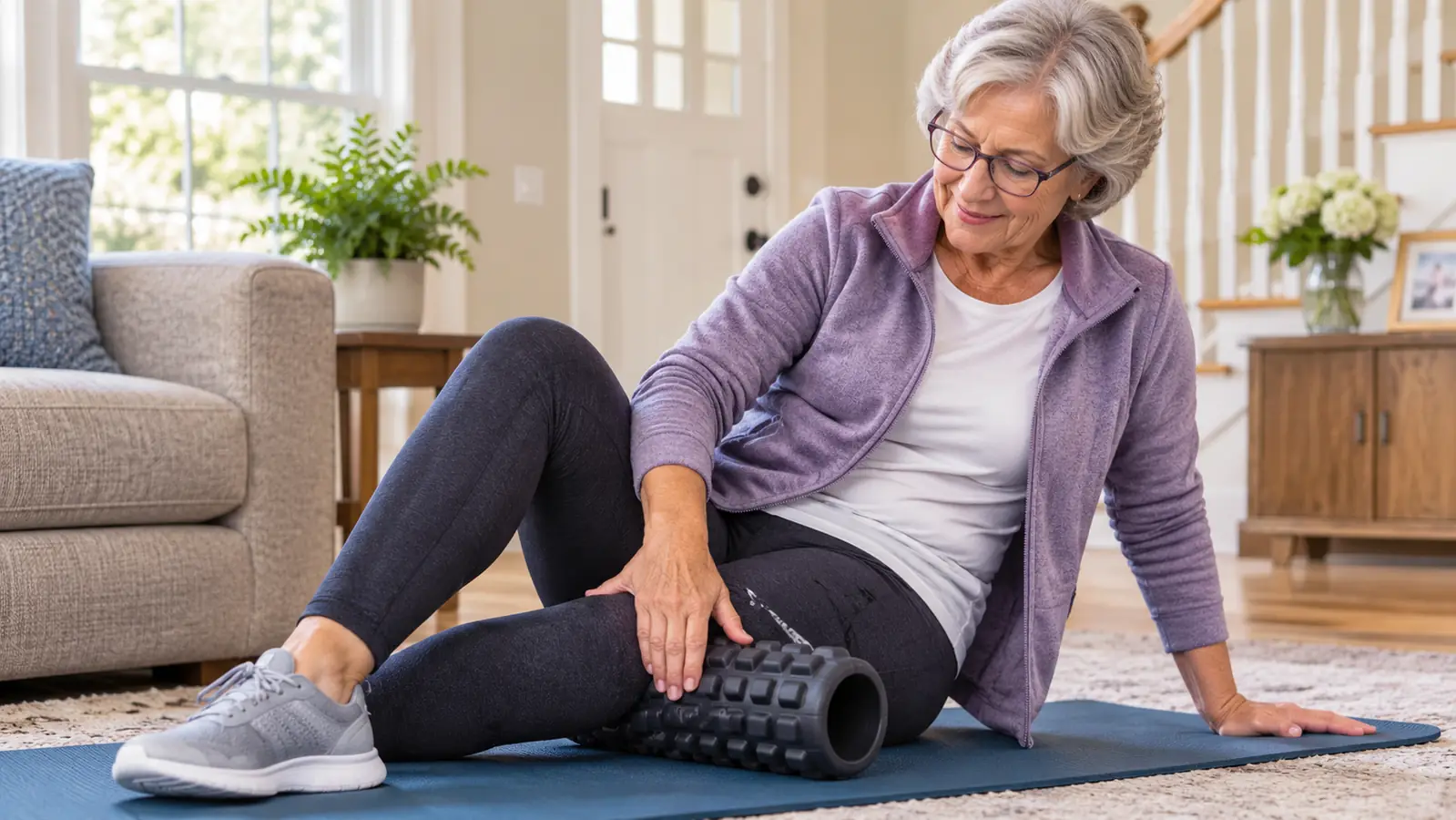
The floor looks heroic. The wall is smarter, and it is where I still do most of my rolling. Stand with your back to a clear stretch of wall. Put the roller between the wall and your upper back, somewhere below the shoulder blades. Bend your knees a little, keep both feet flat, and lean in. Then move slowly, side to side or up and down an inch or two, letting the surface of the roller work on the muscle beside your spine rather than on the spine itself.
The reason to start here is control. Standing up, you can lean in or back off in half a second. If something complains, you simply stand up straight and the pressure is gone. On the floor, with your whole body weight on the roller and your knees in the air, you have to scramble to escape. I have done the scramble. It is not dignified and it is not helpful.
I also use the wall for the sides of my hips, which get tight from the way I favor the right knee. Same idea: roller against the wall, hip against the roller, small slow movements, no grinding. When I first got the TriggerPoint roller I assumed I would be on the floor with it every night. What actually happened is that the wall did most of the work for the first month, and that was the right call.
Step 3: Roll Around the Back, Never On It
Take your spine off the roller. I mean that literally. Rolling directly up and down your lower spine puts pressure where there is no muscle to absorb it, and it is the single fastest way to end an evening with a back that feels worse than when you started. Eighteen months in, I have never once rolled my lower spine, and my physical therapist would have had something to say about it if I had.
What I do roll: the meaty muscles on either side of the lower back, carefully and briefly. The sides of my hips. My upper back, where the shoulder blades live, which is where a lot of my stiffness actually hides. On the floor, my calves and the outsides of my thighs, because those tighten up from walking and from stairs and they pull on everything above them.
And I never roll the knee joint itself. Not the right one, not the left one. The thigh above and the calf below are fine. The kneecap is not a muscle and there is nothing there to loosen. If you are reading this because of knee pain, that rule is worth taping to the roller.
I remember one evening in July of 2025 when I got ambitious on the living room floor and worked the lower right side of my back for a good long while. I felt loose and pleased with myself, and I slept fine. By ten the next morning I had a tender spot the size of my palm and I moved like a woman carrying something fragile for two days straight. That was the last time I gave that area more than about thirty seconds.
Ninety seconds on the sides of my hips does more for my lower back than twenty minutes of leaning on the spot that hurts.
Step 4: Keep It Short and Breathe Through It
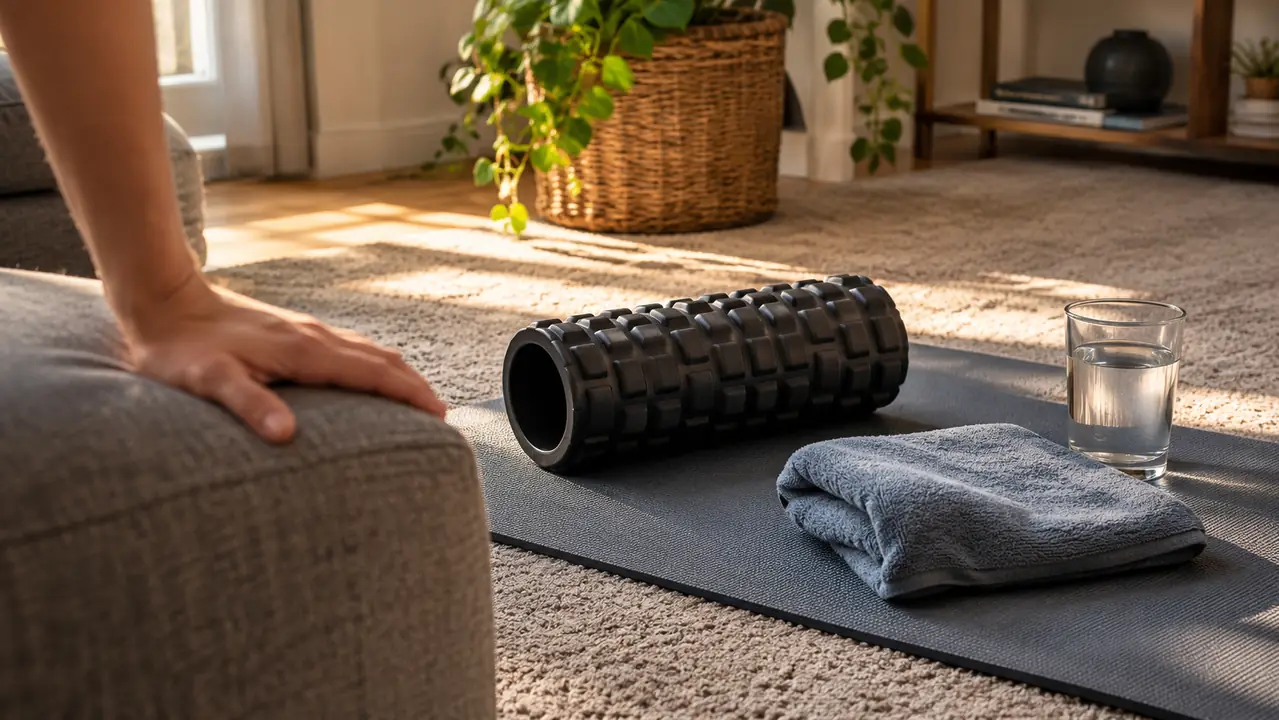
My whole routine takes a few minutes, most evenings. That is it. A minute on one side of the hips, a minute on the other, a minute across the upper back, and on garden days a couple of minutes on the thighs and calves. If you are on one spot for five minutes trying to grind out a knot, you are not loosening anything, you are bruising it.
The number I use is this: keep the discomfort around a three or four out of ten. If you are holding your breath, clenching your jaw, or bracing your shoulders up around your ears, you are past it. Breathe out slowly and let the muscle soften instead of forcing it. The multi-density surface on this roller is designed to do some of that work for you, with ridges and nodules of different firmness, so you do not have to press hard to feel it.
The other thing I had to learn was to quit while I was ahead. There is a strong urge to keep going when something finally feels like it is releasing. That urge has cost me two or three sore mornings. Now I set a timer on the kitchen stove, and when it goes off I am done, no matter how good it feels.
The roller itself has held up better than I expected. The TriggerPoint Grid is 13 inches long and about 1.1 pounds, foam with a multi-density surface of ridges and nodules, and after eighteen months of being leaned on, dropped, and occasionally kicked out of the way, nothing on it has flattened or gone soft. I wipe it down with a damp cloth every couple of weeks and that is the entire maintenance routine.
Step 5: Get Up Slowly and Judge It the Next Morning
Getting off the floor is its own skill when you are 64 and your knee has opinions. Do not sit up like you are doing a crunch. Roll onto one side, put both hands on the arm of the couch or the seat of a sturdy chair, and push up from there with your arms doing the work. I keep a yoga mat on the living room floor for exactly this reason, and I have used the same couch arm for eighteen months.
Then comes the real test, and it does not happen that night. It happens the next morning. If your back feels looser and your first ten steps to the bathroom are easier, whatever you did was about right. If your back is stiffer, or sore in a bruised, tender way, you did too much. Cut the time in half for a week and start again.
I judge progress in weeks, not evenings. Can I get out of the recliner without the little groan. Can I take the stairs to the bedroom without stopping at the landing. Can I spend an hour in the garden beds and still walk the loop with my neighbor the next morning. Those are the measurements that matter to me, and they have moved in the right direction since May of 2025. Slowly. Not dramatically.
For a while I kept a small notebook on the end table and wrote down how each morning went. Not a journal, just a line: the date, how the back felt on a scale of one to ten, and whether I made the walk. Looking back at the pages from the spring of 2025, the marks are mostly fives and sixes with an occasional four. The pages from this fall are mostly sevens and eights. Nothing about that is dramatic. It is just the direction I wanted it to go.
What Else Helps
Rolling is one piece, and on its own it would not have been enough. The heat pad I lie across my lower back for about twenty minutes in the morning, before my walk and before I roll, makes the rolling itself gentler. The exercises my physical therapist gave me in those six weeks are the actual engine, and I still do them most days even when I do not feel like it. On bad knee days the brace goes on before the walk, not after. A one mile loop around the neighborhood with a friend who talks the whole way does more for my back than anything on this list, because it keeps me moving on the days I would otherwise sit.
What I would not do is build a whole evening around the roller. It is a tool for a few minutes, not a treatment plan. If your back is getting worse instead of better, rolling more is not the answer, and neither is a firmer roller. That is a call to your doctor or your physical therapist, and it is a call worth making early rather than after three months of stubbornness. I say that as someone who has done the three months of stubbornness.
Eighteen months, a few minutes a night, still the same thirteen inch roller
Extra firm, 1.1 pounds, a multi-density surface that does the work without you having to press hard. If your therapist has cleared you to roll, this is the one I have used every week since May 2025.
Amazon Check Today's Price on Amazon →