

I bought the HurryCane Freedom Edition in September 2025, on a Tuesday, after my right knee gave out halfway around the one mile loop I walk with my neighbor Ruth. Not a fall. Just a sudden, stubborn refusal to keep going, the kind where you stand very still on the sidewalk and pretend you are looking at a mailbox. I was 63 then. I am 64 now, retired after 31 years as a school cafeteria manager, and I have osteoarthritis in that right knee that I have been managing since I was 59.
This is not a story about a cane that changed my life. It is a story about a tool I reach for on certain days, why I reach for it, and the parts of owning one that the product page does not tell you. I paid for mine with my own money. Nobody sent me one to try. If you are shopping for yourself, or for a parent who will not admit they need anything, here is the plain version, including the parts I do not love.
The Quick Verdict
A genuinely useful folding cane for bad knee days and uneven ground, with one honest limit: at 16 ounces it is not the lightest thing in your bag, and the folding joints are the reason you can carry it at all.
Amazon Check Today's Price →Bad knee days do not RSVP. Keep the cane by the door.
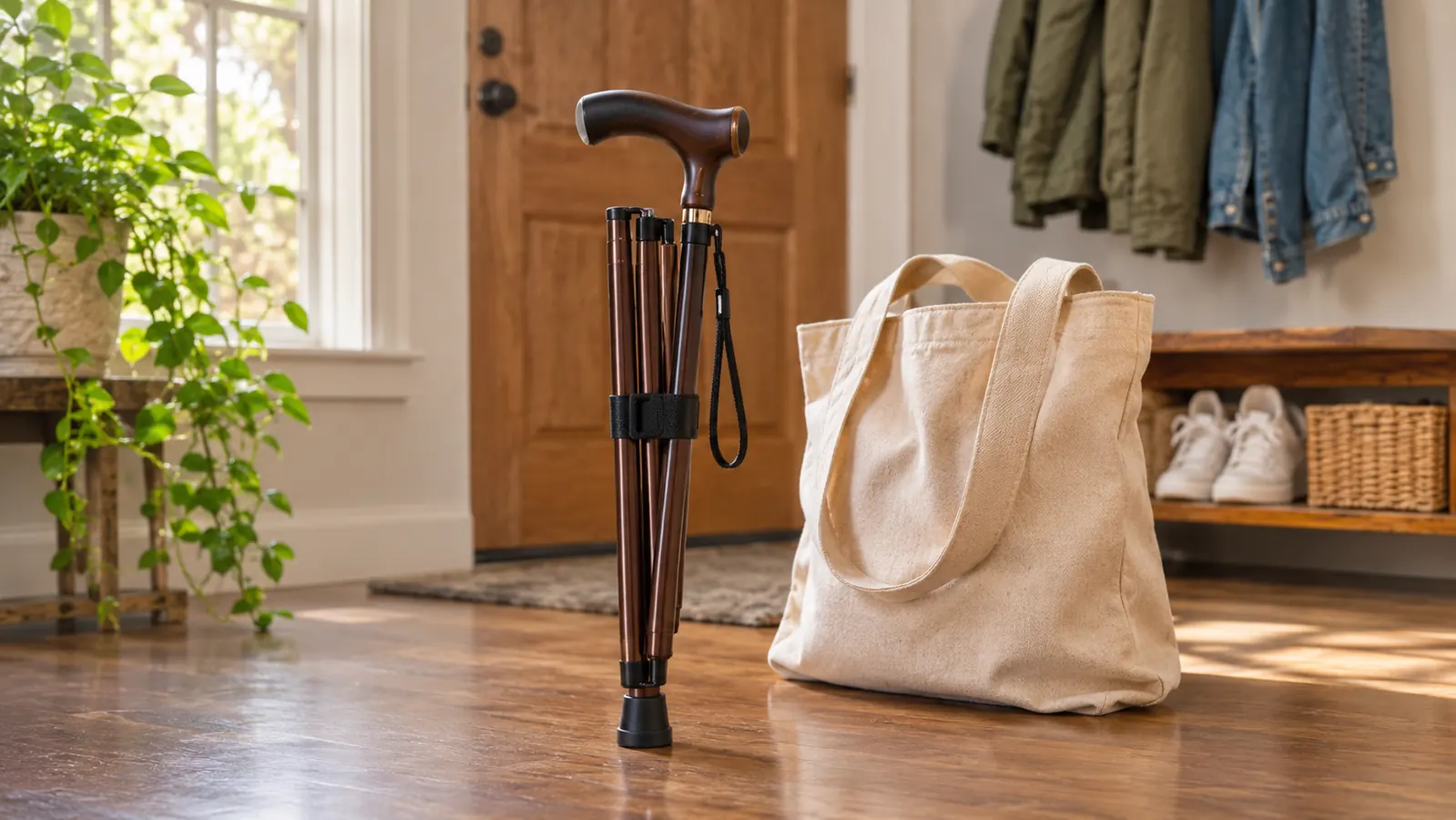
The model I keep by my front door, folded in a tote bag when I leave the house. Fourteen months in and it still stands on its own.
Amazon Check Today's Price on Amazon →What Nobody Tells You Before You Buy a Folding Cane
The first thing nobody tells you is that you will not use it every day. I have had mine 14 months and I would guess it leaves the house three or four times a week, sometimes less. It lives by the front door, and on good weeks it just sits there while I walk my loop with Ruth without it. That is not a failure. A cane is for the days your knee picks the route, not the days you pick it.
The second thing nobody tells you is that folding is the entire reason this design exists, and folding is also the compromise. A cane that breaks down small enough to drop in a tote bag is a cane with joints in it. Joints are where a little wiggle lives. You will not notice it crossing a kitchen floor. You may notice it on a gravel path or a sloped sidewalk, where you want the thing to feel like one solid piece of aluminum and it feels like one solid piece of aluminum with joints in it.
The third thing is that the cane is not the whole answer, and no honest review will pretend otherwise. My knee still hurts on damp mornings. The cane helps me keep walking when it does, which is the only thing I actually wanted from it. If you are looking for something that makes the soreness go away, this is a walking aid, not a treatment, and the soreness itself is a conversation for your doctor or physical therapist.

How I've Used It: 14 Months, Off and On
I bought it in September 2025, during a stretch when the right knee was flaring for no reason I could name. Before that flare I had never owned a cane of any kind. I had a knee brace from physical therapy that spring, and I had been doing the home exercises my PT gave me most days, and I still do. The cane was not a replacement for any of that. It was for the walk.
Where it actually goes with me: the Saturday farmers market in town, where the pavement is old and cracked and there is a slope near the produce tent I used to take too fast. The church steps on Sunday, which are stone and uneven, and where I would rather have a third contact point than not. The raised beds out back on the days I am kneeling and standing and kneeling again, because getting up off the ground is the part that gets me. And the morning loop with Ruth when my knee is talking.
The winter after I bought it was the real test. We get ice on the driveway here in Hendersonville, the thin kind you cannot see, and Gus salts it but not always before I am up. I used the cane to get from the front door to the car for about six weeks straight that January and February. It is not a crampon. It did keep me from walking like I was on a tightrope.
Where it does not go: the grocery store on a normal day, the post office, the twenty minute drive to my daughter Melissa's house. Those are fine. I am not going to carry a cane to prove anything. When it does leave the house folded, it rides in my tote bag, and the bag goes in the Buick, and the cane is there if the day turns.
The thing I did not expect is how much I would use it indoors on the bad mornings. Our house is two stories, fourteen carpeted stairs up to the bedroom, and on a bad morning those stairs are the whole day's project. I do not take the cane up the stairs, because I want one hand on the rail and the other hand free. But I use it crossing the kitchen to the coffee maker, which sounds ridiculous until you have had a morning where the kitchen is far.
The Stability Question, Answered Honestly
Stability is the reason you buy this one rather than a cheap straight cane from a drugstore bin, so it deserves a straight answer. The HurryCane has a base made of resin, and the footprint of that base is the thing you feel. On the tile floor of my kitchen and on the stone steps at church, it sat where I put it. It did not skate. That is most of what I want from a cane.
The handle is a T shape with a rubber grip, and the grip matters more than I thought it would. My hands are not what they were. In October, when the mornings turn cold and my fingers do not want to close all the way, the rubber is the difference between holding the cane and hoping I am holding the cane. I have walked a mile with a damp hand and it did not slip.
The honest limit: a cane is a balance aid, not a handrail and not a piece of furniture. It will help you stay steady on a sloped sidewalk. It will not hold your full body weight if your knee buckles, and you should not ask it to. On the stairs I still take the rail. Getting up out of the recliner, I still push off the arm. If you need something you can lean on hard, ask your doctor or physical therapist what that is. It is not this.
The Fold, the Fit, and Those 13.7 Inches
The folded length is 13.7 inches, which is the number that sold me. Thirteen and a half inches fits in the tote bag I already carry, the one with the long straps, and it fits without the handle sticking up and knocking into my elbow. It also stands up on its own when it is folded, which sounds like a novelty until you are in a checkout line and want both hands for your wallet.
The height adjusts from 30.5 inches to 37.5 inches, and it extends to 37.5 at the top of that range. I set mine once, in September 2025, and it has not moved since. The adjustment is not fiddly and it does not drift, which is more than I can say for the telescoping handle on my old garden cart. If two people in one house share a cane, the range is wide enough, though I would not want to be resetting it every morning.
Opening it takes a second and a half. You unfold it and it locks. The lock type is listed as foldable, and what that means in practice is that the joints are built to hold open, not that you will be fiddling with a latch every time. I have opened it one handed, holding a bag of tomatoes in the other. That is the test I would give any folding cane, and this one passed.
What I Do Not Love About It
Sixteen ounces. That is the weight, and it does not sound like much until you have carried it folded in a tote bag around a farmers market for two hours. The bag gets heavier. My shoulder notices. If I am going somewhere I know will be mostly sitting, the cane stays in the car. I do not think any folding cane solves this completely, because the joints and the base are the weight. But I would be lying if I said it disappears in the bag.
The joints, again. It belongs in the complaints column and not only in the explainer. There are days when I want the cane to feel like one solid piece, and it does not, quite. It is close. It is not the same as a one piece cane. If you have a strong opinion about that, buy the one piece and give up the tote bag.
And the last thing, which is not really the cane's fault: it is a visible admission. I am 64, I have a cane by my front door, and the first month I had about nineteen different feelings about that, most of them not generous. That passed. What helped was noticing that Ruth, who is 66 and has a better knee than mine, borrowed it for the church steps one Sunday and did not say a word about it. Nobody cares. That is the report from the street.
What I Liked
- The resin base sits flat and steady on tile, stone steps and cracked pavement
- Folds to 13.7 inches and stands on its own when folded
- Height range of 30.5 to 37.5 inches covers a wide spread and does not drift once set
- The rubber T handle holds in cold, damp hands
- Limited lifetime warranty
Where It Falls Short
- 16 ounces is heavier than it sounds once it is in a tote bag all morning
- The folding joints make it feel slightly less solid than a one piece cane
- Not a weight bearing aid; stairs still get the rail
- It is not a substitute for the knee exercises that actually help
On the stone steps at church I would rather have a third contact point than not, and 14 months in, that is still the whole reason it lives by my door.
What I Compared Before I Bought
I stood in the drugstore aisle for a while with a plain straight cane in my hand, the kind with the little curved handle and the thin metal shaft. It was lighter. It was also the length of my leg and it did not fold, which meant it was going to live in the car or be carried openly, and I knew myself well enough to know I would leave it at home. That is the entire reason I went home and ordered the HurryCane instead.
I also looked at the four footed canes, the ones with the wide quad base. They look enormously stable, and for some people they are the right answer, particularly if balance is the main issue. For me the dealbreaker was the same one: a quad base does not fold into a tote bag, and it does not stand quietly in the corner by the door. Also, and this is just my own prejudice, they look like a piece of hospital equipment.
I did not buy either of those. I have only owned the one cane, so I can tell you what this one does, and I can tell you what I was avoiding. I cannot tell you a quad cane is worse. I can tell you that a cane you leave at home helps nobody.
The Small Stuff: Warranty, Grip and Wear
The warranty is a limited lifetime warranty. I have not had to use it and hope not to. What I can tell you is what 14 months of use looks like. The rubber grip is intact. The base has some scuffing on the bottom edge from the church steps and the driveway. The joints still lock. Nothing has loosened that I have noticed.
If you buy one, check the base every few months. Not because anything on mine failed, but because the base is the part that touches the ground and the ground is not kind. A worn base on a wet porch step is a slip waiting to happen. It takes ten seconds and it is the one piece of maintenance this thing asks for.
Who This Is For
This is for someone whose knee or back makes certain days harder than others, and who wants to keep doing ordinary things on those days. Grocery runs. The farmers market. Church steps. A walk around the block with a neighbor. A garden. If your knee picks the route now and then, and you have been staying home instead of going, this is a low drama way to go.
It is also, honestly, for the grown children reading this on behalf of a parent. My daughter has bought my husband Gus two things he swore he did not need, and she was right both times. If you are shopping for a parent who is unsteady on steps and will not say so, this folds small enough to keep in the car without it becoming a whole conversation.
Who Should Skip It
Skip it if what you need is something to lean your full weight on, or if you have been told you need a walker or a rollator. A cane is a balance aid. It is not a substitute for the right equipment, and buying the wrong thing delays the right thing. Ask your doctor or physical therapist what you actually need before you spend anything.
Skip it, too, if you know yourself and know you will not carry it. Sixteen ounces in a bag is a real weight, and if it is going to live in the closet, nothing about the fold or the base matters. And skip it if you are looking for pain relief. The cane helps me keep walking. It does not treat the arthritis. The exercises from physical therapy, the ones I still do most days, those are the part that actually helps.
If your knee picks the route now, this is the one by my front door
Folds to 13.7 inches, stands on its own, adjusts from 30.5 to 37.5 inches, and it is still the cane I reach for 14 months later. Talk to your doctor or physical therapist about what you need before you buy anything.
Amazon Check Today's Price on Amazon →