

My right knee announced itself in the middle of the produce aisle, which is a dramatic way of saying I had to stop and hold on to the cart for a second. That was September of 2025. I had been living with osteoarthritis in that knee since I was 59, managing it with the home exercises my physical therapist gave me and a stubborn refusal to slow down. Then the flare-up came, and the one-mile loop I walk most mornings with my neighbor Ruth turned into something I dreaded instead of something I looked forward to.
So I did what I always do. I sat down with my coffee and read Amazon listings for two weeks until Gus asked whether I was buying a cane or running for office. I bought the HurryCane Freedom Edition myself, put it by the front door, and told myself I would only use it on bad days. Fourteen months later it is still by that door, and I use it more than I planned to and less than I probably should. Here is what the HurryCane has actually looked like in my week, in ordinary detail, without anybody telling you it changed their life.
The Quick Verdict
Folds down to 13.7 inches and stands up on its own, which stops mattering to nobody who has tried to lean a cane against a grocery cart. Not the lightest cane on the shelf, and the fold joints click a little on pavement.
Amazon Check Today's Price →The cane that lives by my front door, on the good days and the bad ones
Folds to 13.7 inches, adjusts from 30.5 to 37.5 inches, and stands upright on its own when you let go of it. It has been my uneven-ground cane for fourteen months.
Amazon Check Today's Price on Amazon →How I've Used It
The cane is not a daily habit the way my exercises are. It is a situational tool, and that is exactly how I wanted it. I take the HurryCane on the mornings when the right knee is loud, which is usually the day after I have been in the raised beds out back, or the day after a cold front moves through. I take it when Ruth and I walk the loop and we reach the north stretch of sidewalk where the roots have pushed the slabs up into a mess. I take it to the Saturday farmers market, where the ground is gravel and the crowd does not move in straight lines. And I take it to the church steps, which are old and shallow and somehow harder than the whole flight of stairs at home.
The rest of the time it stands by the door and I walk without it. That is the honest picture. I am not using a cane to get from the recliner to the kitchen. I use it for distance and for ground I do not trust. If you are further along than I am, you may carry one every single day and it will do that job too. If you are where I am, expect a fair-weather friend that shows up when the weather is not fair.
The first week was clumsier than I expected. My physical therapist had shown me to hold the cane in the hand opposite the sore knee, so the HurryCane went in my left hand and moved forward with my right foot. That felt backwards for about three days. Then it clicked, the way a two-step dance clicks, and I stopped thinking about it. If nobody has walked you through that yet, ask before you start, because holding it in the same hand as the bad knee does nothing useful and makes your shoulder tired.
One thing I did not expect: it changed how far I was willing to go. Before, when the knee was acting up, I stayed home. Now I take the cane and go, because I know the walk back is not going to be a problem. That is not the cane healing anything. It is the cane making the decision easier. My physical therapist would tell you the walking is the point, and she would be right.

What the Folding Actually Buys You
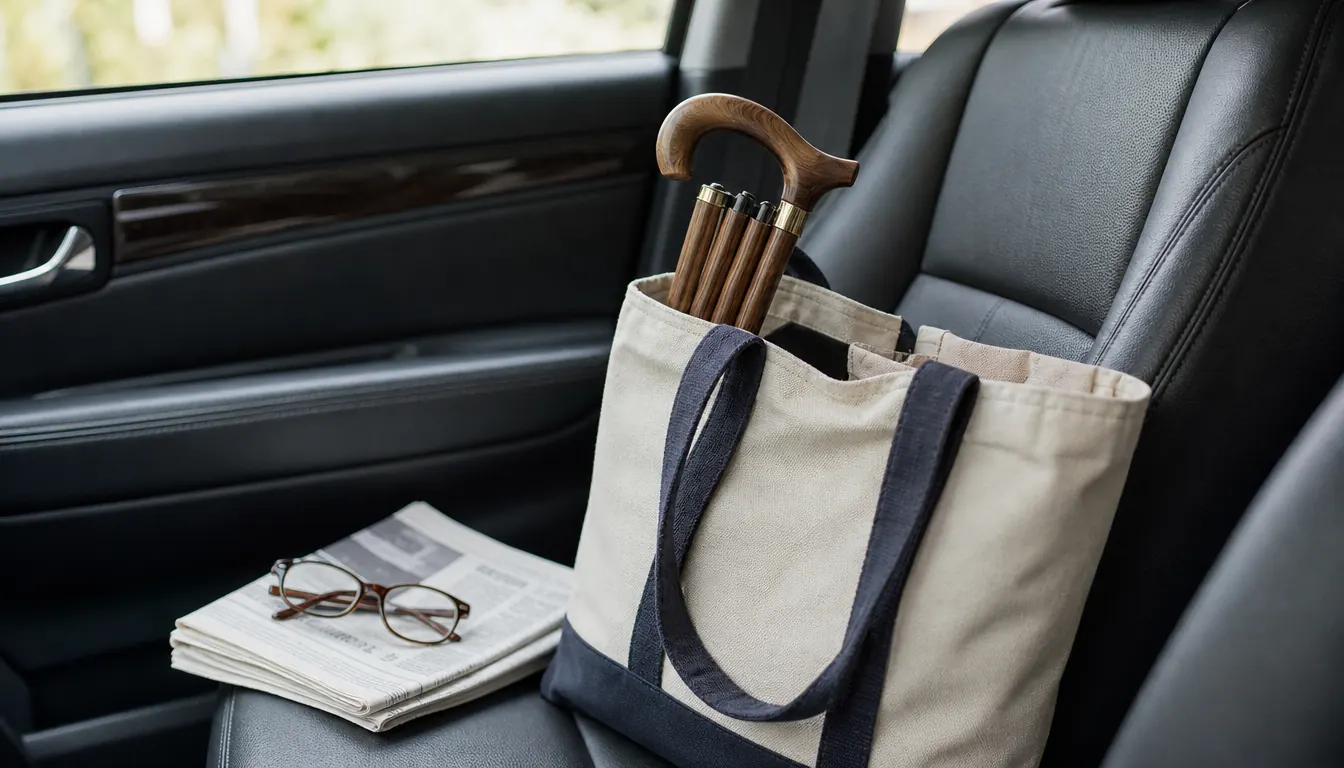
The HurryCane folds into three sections and comes down to 13.7 inches, which is short enough to sit in my canvas tote bag next to the crossword book and a cardigan. That sounds like a brochure line until you have tried to get into the passenger seat of a Buick with a full-length cane and a bag of groceries. I fold it, drop it in the bag, and it disappears. Gus never has to look at it and I never have to explain it to anybody.
It also means the cane comes with me instead of staying home. We drove to see our daughter Melissa and the grandchildren in the spring, and it went in the trunk folded, took up no more room than an umbrella, and came out at the rest stop when I needed it. A rigid cane does not do that. It either rides across the back seat and slides around every time Gus takes a curve, or it stays home and you limp.
At a restaurant it goes under my chair. At the doctor's office it goes in my bag while I fill out the clipboard. At church it goes in the bag during the service and comes out for the steps afterward, which matters more than I would like to admit, because those steps are the reason I started thinking about a cane in the first place. The folding is not a gimmick. For somebody who is not using a cane every hour of every day, it is the whole reason the thing comes along at all. A cane that stays in the closet helps nobody.
Height, Handle, and How It Carries
It adjusts from 30.5 inches to 37.5 inches. I am 5 foot 4 and I have mine set a little below the middle of that range, tall enough that I am not hunched over it and short enough that my shoulder does not hike up toward my ear. Setting it took one try with a tape measure against the kitchen wall, and the HurryCane has held that setting through fourteen months of leaning my weight on it.
The handle is a T shape with a rubber grip, and I have come to prefer it to the crook handle on the cane my mother used. With a T handle your palm sits flat on top and your wrist stays straight. A crook handle wants you to hang your wrist over the curve, which after a mile is its own small complaint. I have not had a blister, a callus, or a sore spot from this handle. I use it bare-handed on the walk and with a glove in cold weather, and neither has made it slippery.
It weighs 16 ounces. That is light enough to carry folded in a bag without noticing and solid enough that it does not feel like a toy when you put weight on it. The shaft is aluminum, the handle is rubber, and the base is resin. It comes with a limited lifetime warranty, which I have not had to test and hope not to.
Gus, who has never used a cane in his life, picked it up once and said it felt sturdier than he expected, then put it back exactly where it was. That is the closest thing to a second opinion you are getting from this house. He drives everywhere, so the cane mostly lives in my bag or by my door rather than in his hands.
The Part I Did Not Expect to Care About
It stands up on its own. When I let go of it, it stays put. This is the feature I would have told you was marketing nonsense before I owned one. Then I got to the pharmacy counter and needed both hands for my wallet, and the HurryCane just stood there beside me like a patient friend. Try that with a cane that falls over every time you turn around, and you will understand why this one detail is worth more than half the other features combined.
It matters most at the farmers market, where I need one hand for the tote and one hand for money. It matters at the church door, where I need both hands for the railing on the steps. It matters in the kitchen when I am reaching for the jar on the second shelf and do not want to set the cane on the floor because I will not be able to pick it back up without a production. A cane that stays upright when you let go is a cane you actually use instead of a cane you fight.
Where It Falls Short
The fold joints click. On a quiet sidewalk you can hear it, a small tick with each step, and the cane has a little more give in it than a solid one-piece cane. I noticed it for the first week and now I do not. But if you want something that feels like a single rigid piece of metal in your hand, the HurryCane is not that cane, and you should know it before you buy. My neighbor Ruth noticed the tick before I did, and she notices everything.
The base is wide, and that width is the trade you make for the stability. On gravel at the market it is fine. In the loose soil of the raised beds out back it sinks, and I end up setting it against the fence and holding the fence instead. On a wet tile floor it can feel like it wants to slide if I plant it too far ahead of me. I learned to set it down closer to my feet, and I learned to wear the shoes with the tread on them.
And the honest one: the cane does nothing for my back. My lower back still stiffens after a garden day and still complains first thing in the morning. That is the heating pad's job in this house, and the cane does not touch it. Nobody should buy a cane expecting it to be a back treatment. It is a walking aid. Talk to your doctor or physical therapist about what belongs in your own routine, because mine is mine and not a prescription for yours.
The last thing, and it is not the cane's fault: it took me a while to be willing to be seen with it. I am 64 and I spent thirty-one years on my feet in a school cafeteria, and I did not love the idea of people holding doors for me. What got me past it was realizing that the alternative was staying home, and staying home is worse. Nobody at the market has said a word about it. Ruth told me it looked sensible, which from Ruth is high praise.
What I Liked
- Folds to 13.7 inches, small enough for a tote bag or a car trunk
- Stands upright on its own when you let go of it
- Adjusts from 30.5 to 37.5 inches, which covers a wide range of heights
- T handle with a rubber grip keeps the wrist straight on longer walks
- 16 ounces, light enough to carry folded without noticing
- Limited lifetime warranty
Where It Falls Short
- Fold joints click audibly and the cane has a little give next to a one-piece cane
- The wide base sinks in loose garden soil
- Can feel like it wants to slide on a wet tile floor if you plant it far ahead of you
- Does nothing for lower-back stiffness
- Costs more than the plain cane at the pharmacy counter
I can get from the car to the church steps without counting the steps anymore. That is the whole review, really.
Who This Is For
This is for the person who does not need a cane every hour but needs one often enough that staying home has quietly become the default. If your knee is loud on uneven ground, if the farmers market and the church steps and the far end of the parking lot have dropped off your list one by one, the HurryCane will put them back on the list. It is also for the grown children reading this on behalf of a parent, because the folding is what makes it easy to say yes to. A cane that fits in a bag is a cane that does not feel like an announcement.
It is also for the person who wants one thing that does not need a routine. My exercises need a routine. The heating pad needs twenty minutes and a recliner. The cane needs you to pick it up and go, and if you leave it by the front door you will. That is the entire program.
Who Should Skip It
If you need a cane for balance every single day on hard floors and carpet, a solid one-piece cane will feel steadier in your hand and you will not care about the folding. If you need a rollator or a walker for stability, this is not a substitute and please do not use it as one. If you want something for loose soil and garden beds, buy a good trowel and use the fence. And if you have not been evaluated for the knee at all, start there. A cane is a tool for living with a knee, not a way around finding out what is going on with it.
Fourteen months later, it is still standing by my front door
Folds to 13.7 inches, adjusts from 30.5 to 37.5 inches, and stands on its own when you let go. The HurryCane has been the difference between skipping the walk and taking it.
Amazon Check Today's Price on Amazon →