

Stairs are where a cane earns its keep, and stairs are where most people quit using one. Not because the cane does not help. Because nobody showed them how to set it up, or which foot goes first, or what to do with the thing when both hands are full. I put off buying a cane for a year because I did not want to be the woman with a cane, and then my right knee made the decision for me in September 2025, on the fourteenth step of my own staircase. I bought the HurryCane Freedom Edition myself, on Amazon, after six weeks of physical therapy convinced me that a single-point cane on bad days was a reasonable thing to do rather than a surrender.
What follows is the plain version of what those fourteen months taught me, on my own fourteen carpeted stairs, on Ruth's gravel driveway, on the church steps, and on the lumpy grass of the Saturday farmers market. Sizing comes first, before you take a single step. Then the stairs, one direction at a time. Then uneven ground, which is a different skill again. None of this is medical advice and I am not qualified to give any. Ask your doctor or physical therapist whether a cane suits your knee or your back, and ask them to watch you take a few steps. Then come back and read the practical part, which is the part nobody explained to me.
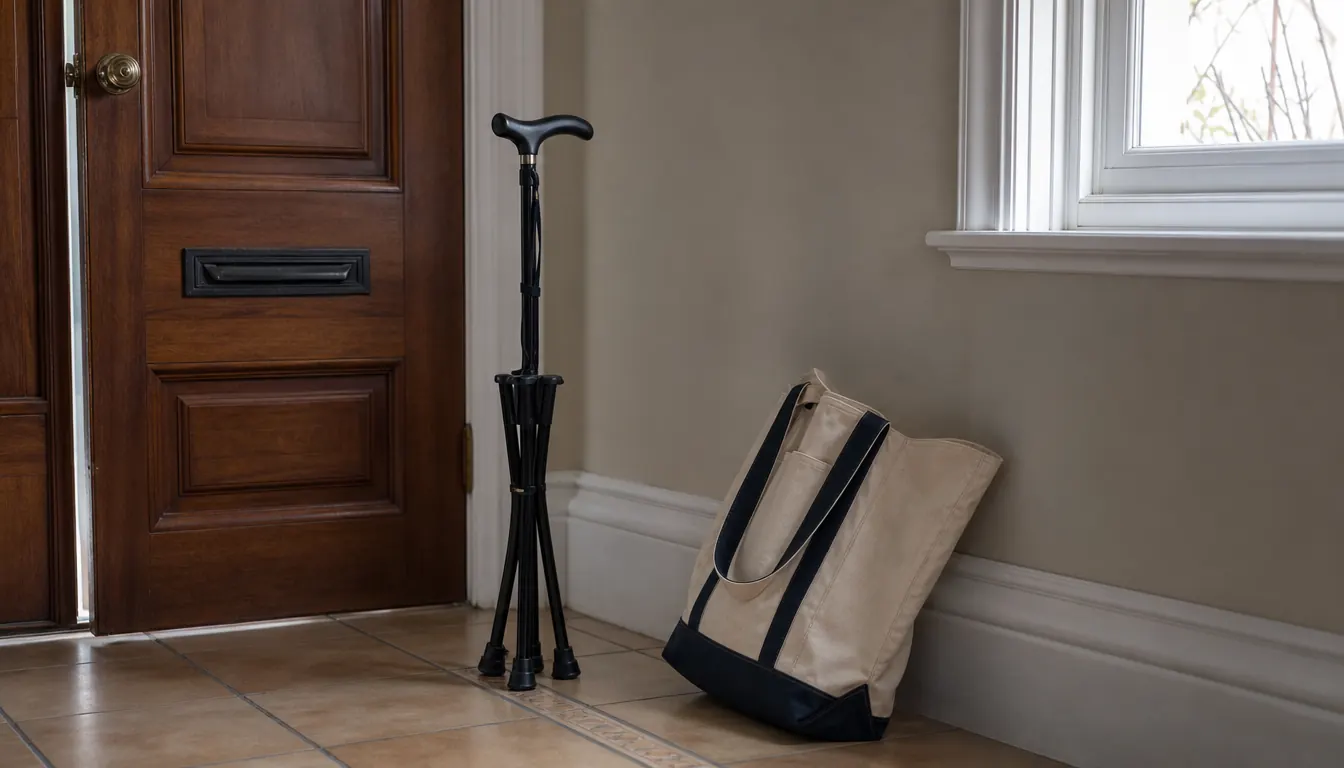
The cane that lives by my front door and folds into my tote bag
14 months of daily-ish use on stairs, gravel and wet leaves. Aluminum, adjusts from 30.5 to 37.5 inches, folds to 13.7 inches, and stands on its own when I need both hands.
Amazon Check Today's Price on Amazon →Step 1: Measure at the wrist, not at the hip
Put on the shoes you actually walk in. Not slippers, not socks. Stand up straight beside a wall with your arms hanging at your sides, and have someone mark the wall at the crease of your wrist, the soft line where your hand meets your forearm. Measure from the floor to that mark. That number is your starting height. Mine came out at 31 inches in my walking shoes, and the handle of a cane set correctly should sit roughly at that line when you are standing on level ground.
Most people guess, and most people guess high. A cane that is too tall forces your shoulder up toward your ear and makes your arm do work it should not be doing. A cane that is too low tips you forward into the exact hunched posture that makes a lower back sore by lunchtime. The HurryCane adjusts from 30.5 inches to 37.5 inches, which covers a wide range of people, and at 31 inches I was sitting one notch up from the bottom with room to spare. If you are tall, or you are buying for someone tall, check that range against the measurement before anything else.
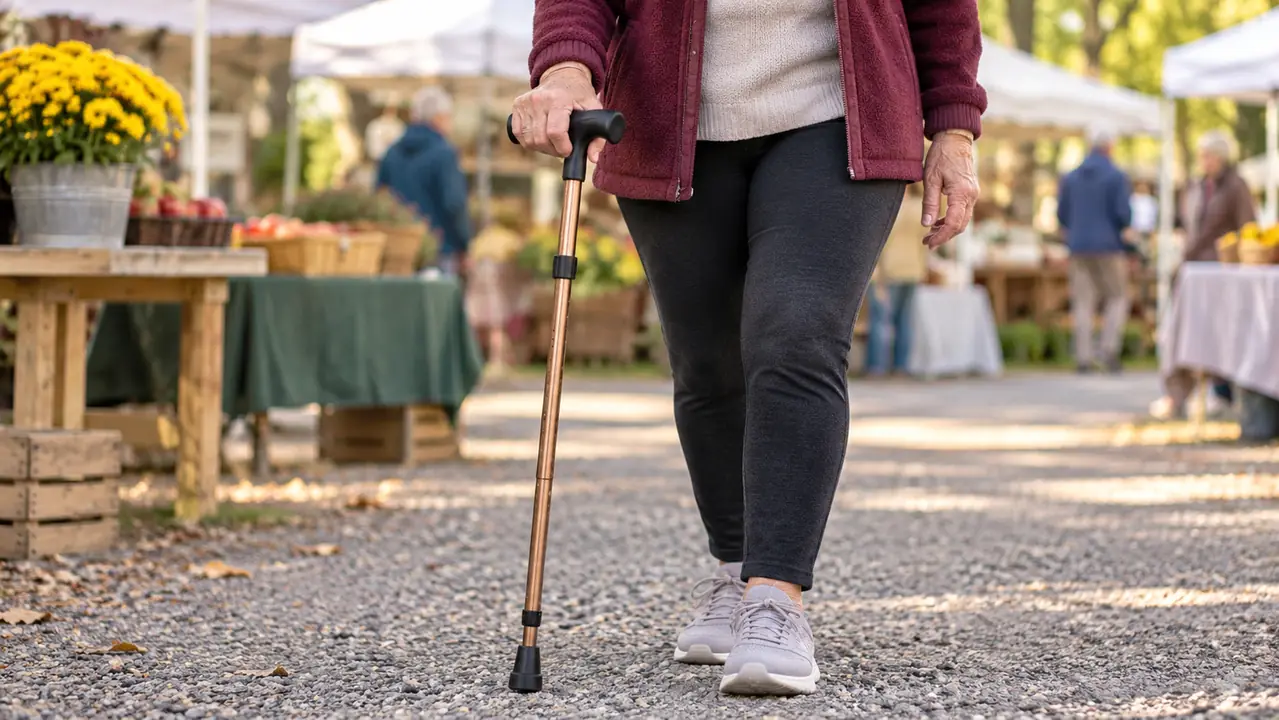
Then decide the hand, because this trips up almost everyone. You hold the cane in the hand opposite the sore side, not the same side. My osteoarthritis is in the right knee, so the cane lives in my left hand. That felt wrong for about two days, like buttoning a shirt the wrong way. Then it stopped feeling like anything, because the cane and the sore leg move together and split the load between them. If both sides bother you, ask your physical therapist which hand to start with.
Step 2: Set the height, then test it with your weight
Unfold it all the way until the sections lock. The HurryCane is aluminum with a folding lock, and when it is fully open it behaves like an ordinary straight cane, so there is nothing to think about once it is set. Push the height pin in, slide to your number, and let the pin seat. Then, before you trust it, press down hard on the handle with both hands and lean some weight onto it. I do this every single time and it has never given.
The handle is rubber over a T shape, which is a small thing that matters on a long morning. Sixteen ounces does not sound like much until you have carried a cane around a farmers market for two hours, and aluminum is the reason it does not feel like carrying a fence post.
Stand it up and let go. The resin base lets it stand on its own, which I did not expect to care about and now use constantly. At church I can let go, pick up a hymn book, and not have the cane clatter down the aisle in the middle of the second verse. At home it stands by the front door where I can find it in the dark without patting around for it. If that sounds like a small feature, wait until you are juggling a casserole dish.
Step 3: Going up, the strong leg leads
Use the handrail. I mean it. Hand on the rail, cane in the other hand, and then the pattern is: strong leg up first, then bring the sore leg and the cane up to meet it on the same tread. One step at a time, with both feet and the cane settled on that step before you think about the next one. It is slower. It is also the arrangement with the most support you can build out of a staircase, and no physical therapist I have met has ever told me to be brave instead.
I have fourteen carpeted stairs up to the bedroom, and for the first week I counted them out loud like a child learning to climb. It felt ridiculous. It also meant I was never surprised by the top, and being surprised by the top of a staircase is how people end up on the floor.
If there is no rail, turn sideways and use the wall, or take one step and pause before the next. If the stairs are steep or the day is a bad one, sit down and go up on your bottom. I have done that too. Nothing happened, nobody was watching, and I still got to the bedroom.
When you reach the top, take a second. Step away from the edge of the stairwell before you start talking or reaching for a light switch. Half the near-misses I have had in my own house happened in the two seconds after the climb, not during it.
Step 4: Coming down is the opposite, and it is the one that matters
Down is where people fall, because down feels easier and it is not. The pattern reverses: cane and sore leg down to the next tread first, then the strong leg comes down to join them on the same step. Cane plants, sore leg follows, strong leg finishes. Say it out loud once or twice and it stops requiring thought.
Down is riskier for three reasons that have nothing to do with courage. You cannot see your feet as well, gravity is helping whether you invited it or not, and the sore leg is the one doing the reaching. My treads are carpeted, which is forgiving, but the last step onto the hall floor is where I have caught myself hurrying. So I do not hurry on the last step.
One more caution. Coming down with a bag in one hand and a cane in the other is a bad trade. Set the groceries at the top and carry them down in two trips, or ask somebody to bring them. My knees do not care about my dignity, and neither does a bag of apples.
Step 5: On uneven ground, slow down and feel ahead
Grass, gravel, mulch, cracked sidewalk, wet leaves, and the Saturday farmers market. On uneven ground the cane stops being something you lean on and becomes something that feels ahead of you. Plant it a short step forward, watch where it lands, and keep your stride shorter than feels natural. If it goes into a hole or slides on loose gravel, you want that to happen with almost no weight on it.
Ruth's driveway is gravel and I keep the cane open the whole way down it. The market is the same. In the grocery store, where the floor is flat and there is a cart to hold, I fold it and drop it in my tote, because a cane in the way in a crowded aisle is its own kind of hazard. Folded, it is 13.7 inches, so it fits in the bag I was already carrying, which is the reason it comes with me instead of riding around in the trunk.
The two surfaces I genuinely dread are wet leaves and smooth painted concrete, which is what the church steps become after rain. More than gravel. Gravel at least announces itself. Take the cane, take the ramp, and take the long way around. Nothing on my Saturday list is worth a fall.
Look the cane over every few months. Anything that touches the ground wears, and wear is quiet. It works fine on the hall floor and then behaves differently on a wet ramp, so check the base before the weather turns.
What Else Helps
Shoes with tread and a firm heel, worn in the house as well as outside. This made a bigger difference to my stair confidence than anything except the cane itself, and it cost me nothing because I already owned them.
A night light on the stairs. I have two, one at the top and one at the bottom, and they are the reason I have not missed a step at three in the morning on the way to the bathroom. Boring, cheap, and better than being careful.
The exercises. I did six weeks of physical therapy in the spring of 2025 and I still do the home program most mornings, which is the only reason any of this works. A cane does not build anything. It buys you the ability to keep moving while the exercises do their slow work. On the worst days I also wear a brace on that knee for the walk with Ruth, and I keep a heating pad and a foam roller around for my back, but the cane and the exercises are the two that changed my week.
And tell the people you walk with. Ruth and I have done the same one-mile loop for years, and she now slows down on the cracked section of sidewalk without being asked, which is worth more than any gadget. Melissa, my daughter, knows that if I turn up to Sunday dinner without the cane, it means I left it in the car by accident.
Last thing: keep it where you will see it. Mine lives by the front door, and folded in my tote. A cane in a closet is a cane you will talk yourself out of using on the exact morning you need it.
The cane did not fix my knee. What it did was let me keep going up my own fourteen stairs to my own bed, instead of moving a recliner into the dining room and calling that my life now.
Fourteen months in, it is still the first thing I grab on a bad-knee morning
I am not going to tell you it cured anything. It let me keep my stairs, my walking loop and my Saturday market. Adjusts 30.5 to 37.5 inches, folds to 13.7 inches, stands on its own, limited lifetime warranty.
Amazon Check Today's Price on Amazon →