
Morning is the worst hour for my back. It always has been, and after thirty-one years on a tile cafeteria floor it still is. I wake up, swing my legs over the side of the bed, and for about ten seconds my lower back tells me exactly how the day is going to go. Some mornings I stand up straight right away. Most mornings I shuffle to the bathroom like a woman ten years older than I am, one hand on the wall for company. I bought a RENPHO heating pad in October 2024, on a Monday, after a weekend of fall garden cleanup left my back so locked up I could not put on my own socks. Two years later it still lives folded in a basket beside my recliner.
This is not a story about a pad that fixed me. Nothing fixed me. What the pad does is buy me twenty minutes of warmth in the morning so that the walk with my neighbor Ruth is a walk instead of a shuffle. That is the whole claim, and it is enough. What follows is how I actually use it, the mistakes I made in the first few months, and the rules I do not break anymore. Before any of that, one plain sentence: I am not a doctor, and heat is not right for every back. If you have not talked to your own doctor or physical therapist about heat for your back, do that first. It costs one phone call.
The Heating Pad That Made My Morning Walk a Walk Again
The size is the thing. At 24 by 33 inches it covers my whole lower back with room to spare, and it lies flat instead of wandering off the cushion while I sit.
Amazon Check Today's Price on Amazon →Step 1: Set the Pad Up Before You Sit Down
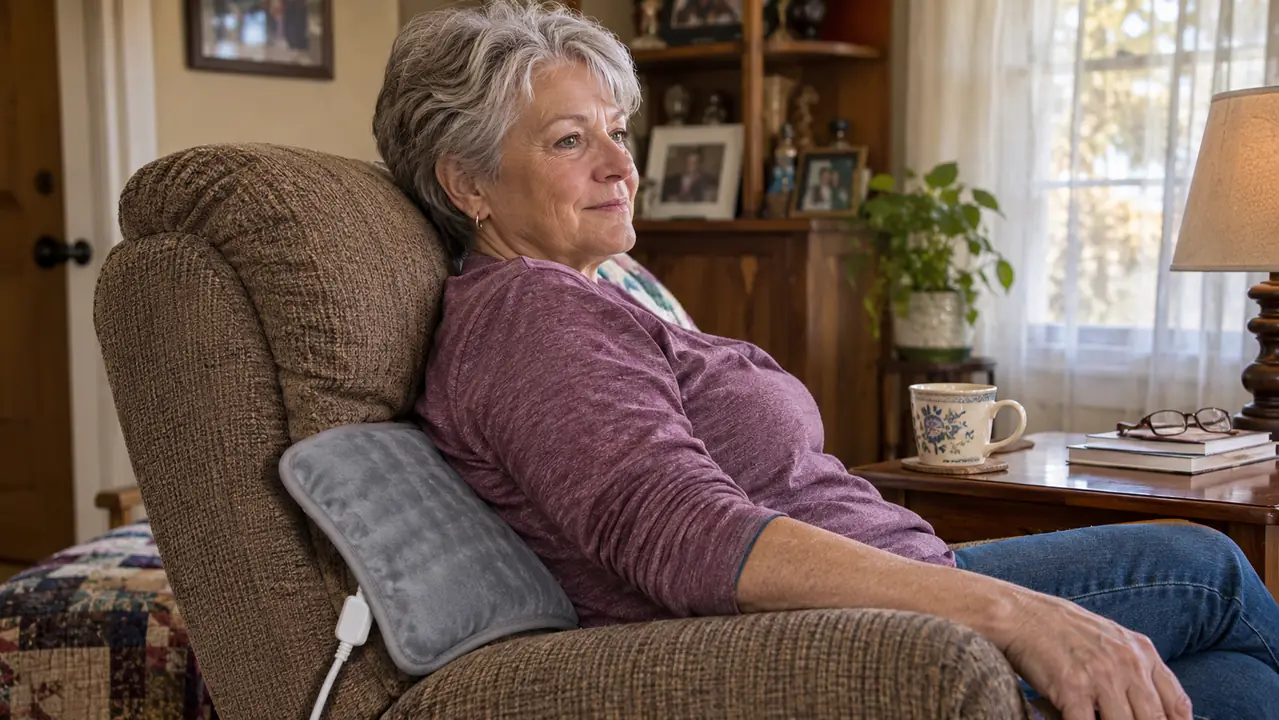
The first thing I got wrong was how I laid the thing out. I used to drop the pad on the recliner seat, sit on it, and lean back. Half of it was under my legs and the part against my back was bunched into a wad the size of a fist. Heat does not travel through a wrinkle. Now I drape it against the back of the recliner so it hangs flat from my shoulder blades down to my tailbone, then I sit back against it. The RENPHO pad is 24 by 33 inches, which means it covers my whole lower back with several inches to spare, and the flannel cover stays where I put it instead of sliding down the cushion the second I lean back.
Two things I will not do, and I learned both the hard way. I do not sit on it, and I do not fold it over on itself while it is running. A folded pad traps heat in one spot, and that spot gets hot in a hurry. I also do not stuff it behind my back like a cushion and lean my full weight into it. It goes between me and the chair back, flat, with maybe the weight of my shoulders on it and nothing more.
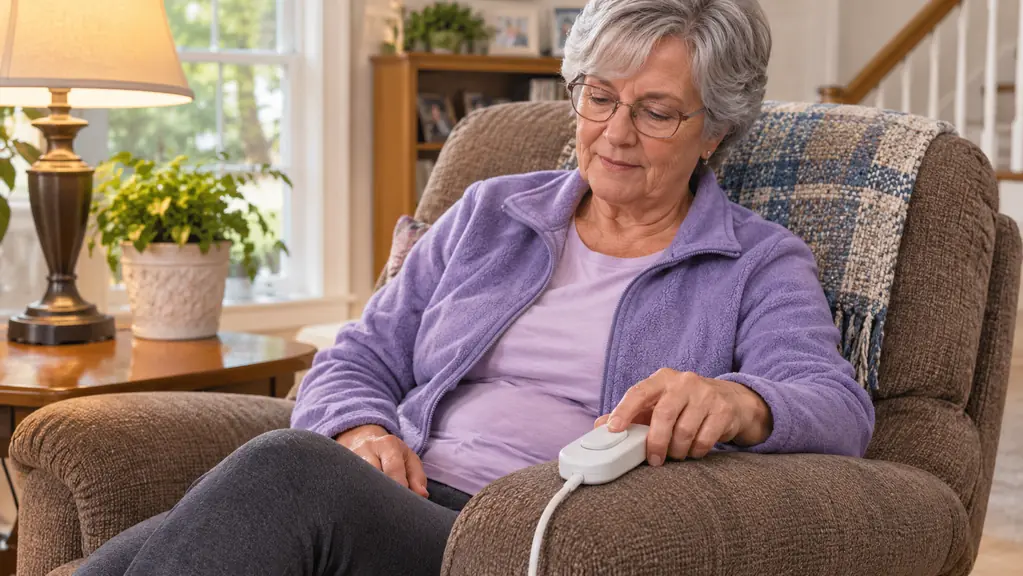
One small thing that made a bigger difference than I expected: I set the controller on the arm of the recliner before I sit down, not after. If I have to lean forward and fish around the side of the chair for it, I have already undone half the loosening I just paid for. It also keeps me from dragging the pad out of position while I hunt for the buttons.
Step 2: Start Low and Give It Five Minutes
The RENPHO controller has 6 heat levels, running from 100F to 150F. My first week I went straight to level 4, because in my head more heat meant more relief. That was wrong twice over. I ended up with a red patch across my lower back that took three days to fade, and I never sat still long enough at a comfortable setting to loosen up at all, because I kept shifting around trying to get away from it. Now I start at level 2. In January, or after a garden day, I go to 3. I have used 4 exactly once since, and I did not enjoy it.
Here is the test I use, and it is not sophisticated. Warm, not hot. If the pad is the first thing I am thinking about instead of my back, it is too high. If I have to lift my shirt to check whether a spot is burning, it is too high. And if my skin is still pink twenty minutes after I get up, that was too much, and the next morning I drop a level. Give the low setting five full minutes before you decide it is not doing anything. It is doing something. You just are not fidgeting, which is the entire point.
This matters more as you get older, and it is worth saying out loud. Skin gets thinner, and some of us are on medications that change how much sensation we have back there. My doctor put it plainly when I asked: if you cannot feel the heat coming on, you cannot feel it building either. If you have diabetes, circulation trouble, or numbness anywhere in your back or legs, ask before you use one of these at all. That is a conversation for your doctor, not for me.
Step 3: Set the Timer Every Single Time
The RENPHO pad has 3 auto-off timer settings, and if you do not set one, it shuts itself off after 60 minutes anyway. I set the timer even when I am absolutely certain I am getting up in twenty minutes. Especially then. The morning I am certain is the morning Melissa calls about the grandchildren, or the crossword gets interesting, or I close my eyes for what I tell myself is one minute.
I have nodded off in that recliner with the pad running. Twice. Both times I woke up sweaty and stiff, which is the opposite of the point, and both times I was lucky. That is the reason the timer gets set before the pad gets turned on, every morning, no exceptions. It has become like putting on my glasses. I do not think about it, I just do it.
The other rule is simpler. The pad never goes in the bed, and I never lie down on it and pull a blanket over myself. It stays in the recliner in the living room where I am sitting upright and awake. If I am going to be horizontal, that is a different part of the day and a different setup, and I would rather do without the heat than fall asleep on top of it.

Step 4: Twenty Minutes, Then Get Up and Move
Twenty minutes is my number, and then I am up. Heat loosens things, but it does not keep them loose. The first month I used the pad, I would sit with it for forty minutes, feel wonderful, stand up, and be stiff again before I reached the kitchen. The warmth was doing its job and I was wasting it by sitting still afterward.
Now the pad is the first half of a two-part morning. Twenty minutes of warmth in the recliner with my coffee, then shoes on and out the door for the one-mile loop with Ruth. That walk is what actually works the stiffness out. The heat just makes the first hundred yards possible. On the days I skip the walk and stay in the chair, I can feel the difference by ten in the morning. My back is right back where it started, only warmer.
Rainy days I do not get a pass, I just change the second half. I walk the hallway, up and down the 14 carpeted stairs once, and then do the exercises my physical therapist gave me in the spring of 2025. Ten minutes of that and I am in better shape than I would be after an hour in the chair. The pad and the movement are a pair. One without the other is only half a routine.
Step 5: Know the Signs That Mean Stop and Call Somebody
There is a version of this where heat is the wrong tool, and it is worth knowing what that looks like before you are in the middle of it. If the pain is getting worse instead of easing over the twenty minutes, stop. If anything goes numb or tingly, or you feel a shooting feeling down into a leg, stop and call your doctor. If your skin looks blotchy, or you find a bruise you cannot account for, that is a stop too.
Heat also does not belong on skin that is already angry. A sunburn, a rash, a spot that is swollen or hot to the touch on its own, all of that is a no. And if you have a new injury, something you did yesterday in the garden that is still swelling, heat is not the first thing you reach for. That is a question for your doctor, and the answer is often not what you expect.
The pad has never fixed anything. It buys me twenty minutes of warmth so the walk with Ruth is a walk instead of a shuffle, and then the walking does the rest.
What Else Helps
The pad is one piece of a morning, not the whole thing. The walk with Ruth is the piece I would give up last. We go most mornings, one mile around the neighborhood, and we have been doing it long enough that she knocks whether it is cold or not. On the days my right knee is acting up, I take the folding cane and we go slower. It is not a race. It is twenty-five minutes of moving that I would otherwise spend sitting.
The exercises from physical therapy are the other piece. Six weeks in the spring of 2025, and I still do most of them at home, which surprises me more than anyone. They are not interesting. They take about ten minutes. But when I skip them for a week, my back gets cranky in a specific way I have learned to recognize, and no amount of heat covers for it.
Around the house, small things add up. My lumbar pillow goes in the passenger seat of the Buick when Gus drives, and it comes into church with me on Sundays because those pews are hard as a board. The foam roller gets a few minutes in the evening against the wall for my upper back and the sides of my hips, and on the living room floor for my calves and thighs, with the arm of the couch to help me back up. I never roll directly on my lower spine or on the knee itself. The RENPHO pad goes back in its basket by noon and does not come out again until the next morning, which keeps it from turning into something I sit on all day. And in the garden I split the work into two sessions now instead of one long Saturday, which my back appreciates even if the beds take an extra day.
None of this is dramatic. That is rather the point. Stiffness in the morning is something I manage, not something I beat, and the managing is mostly a handful of small habits stacked in the same order every day. Warmth first, then movement, then the rest of my life. If your morning looks anything like mine, that order is worth trying, and worth running past your physical therapist before you make it a habit.
If Your Back Is Cranky Before Your Feet Hit the Floor
Six heat levels, three timer settings, and a 24 by 33 inch pad that covers a whole lower back. Mine has been in the basket beside my recliner for two years.
Amazon Check Today's Price on Amazon →