

My lower back has been cranky since the late 1990s. Thirty-one years in a school cafeteria will do that, most of it on a tile floor, much of it lifting stock pots and milk crates I had no business lifting alone. I retired, and the back did not get the memo. It is worst first thing in the morning and the day after I have been out in the raised beds.
What finally made a dent was not a stretch or a gadget. It was noticing that I spent most of my sitting hours with nothing behind the small of my back. A kitchen chair has a flat wooden back. A car seat curves where the car wants to curve, not where I want it to curve. I bought the Everlasting Comfort lumbar support pillow in January 2025 and have used it most days since, mostly on the passenger seat of our Buick when Gus drives and carried into church on Sundays for the hard pew. But the pillow alone did nothing until I set it up right. Here is what I learned, in order. Before you start changing how you sit, check with your doctor or physical therapist, because a stiff lower back has more than one cause and mine is not yours.
The cushion I strapped to the passenger seat and never took back out
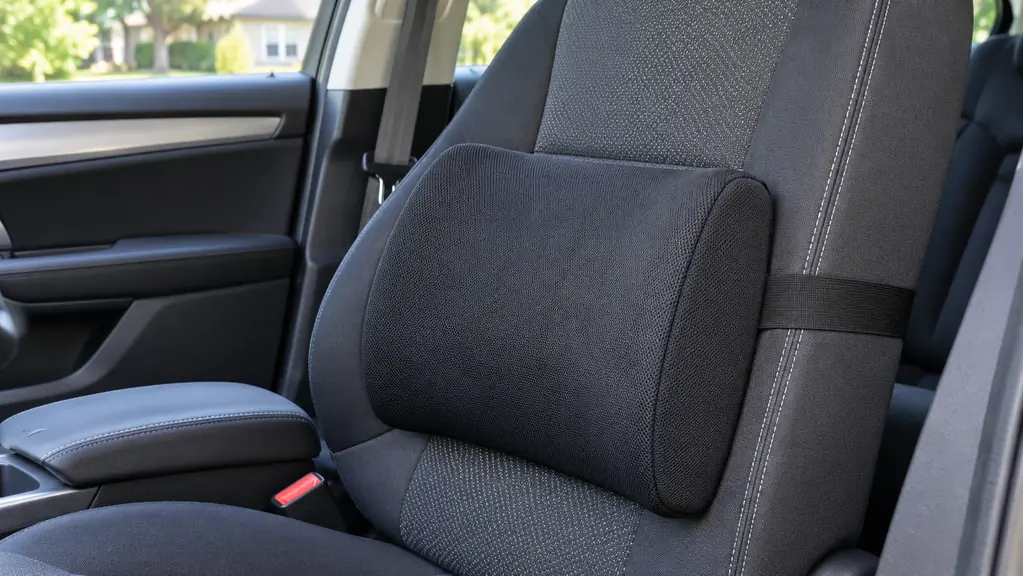
Memory foam, a removable cover, and two adjustable straps with extension pieces so it stays where you put it. It is the one I have used about 22 months.
Amazon Check Today's Price on Amazon →Step 1: Find the spot that actually needs the support, not the spot that looks right
Almost everybody puts a back cushion too high. I know because I did. The first week I had the Everlasting Comfort cushion, I shoved it up behind my shoulder blades, because that is where a chair back feels empty. It did nothing for the ache and made my shoulders feel pushed forward.
Before the cushion arrived I tried a rolled-up bath towel, because my neighbor Ruth swore by one. It worked for about ten minutes and then went flat, and it never stayed where I put it. If you want to test the idea before you spend anything, a rolled towel will tell you whether pressure in that spot helps at all. Where it falls down is holding the shape. Memory foam does not flatten out by lunchtime, and the towel does.
What you want is contact with the small of your back, the inward curve just above your belt line. Sit down, roll your hips forward and back a few times, and feel where your spine dips in. That dip is the target. The cushion should press gently into it, not into the flat of your back above it.
The Everlasting Comfort pillow is rectangular and measures 13 inches long by 12.6 inches high, with about 3.5 inches of depth. That is bigger than it sounds when you are holding it. On a kitchen chair it covers a good stretch of your back, so the top edge will sit near your ribs. That is fine. What matters is that the thickest part of the foam is level with the dip, not above it.
Step 2: Get your seat height and your feet right before you adjust anything else
Here is the part I wish someone had told me two years ago. A cushion cannot fix a chair that is the wrong height. If your seat is too high, your feet dangle, your thighs tip forward, and your lower back rounds no matter what is behind it. If your seat is too low, your knees come up above your hips and the same thing happens.
At my kitchen table I ended up putting a folded towel under the cushion of my chair to bring it up about an inch. At my daughter Melissa's desk, where I sometimes sit with the grandchildren while they do homework, the chair was too tall and I used a footstool instead. Either fix takes a minute and neither costs much.
I checked the towel fix the lazy way, by sitting down and having Gus look at whether my knees were level with my hips, because my own sense of level is not reliable and never has been. He said I was still slightly high, so we added a second folded towel. Two towels, about an inch and a half total, and that was the end of it.
The test: sit all the way back, feet flat on the floor, knees roughly level with your hips. If you cannot get there, fix that first. Then place the cushion. A lumbar pillow is doing support work, not structural work.
Step 3: Strap it on so it stays where you set it
This was the thing that made the difference between the cushion working and the cushion being a nuisance. Loose, it slides down within twenty minutes and you are back to a flat back and a sore morning.
The Everlasting Comfort pillow comes with dual adjustable straps plus extension pieces, and the extension pieces matter on a wide seat. On the Buick's passenger seat I ran both straps around the seat back and clipped them behind, then pulled them snug. Not so tight that the foam compresses flat, just snug enough that the cushion does not walk. It has been in that spot since roughly February 2025 and I have not had to redo it.
One caution I learned the hard way. Do not tighten the straps while you are already leaning back against the cushion. Sit forward, pull them snug, then lean back and see where it lands. The first time I did it leaning back I pulled the foam into a wedge and had to undo both sides and start over, which is a silly thing to do to yourself at seven in the morning.
At the kitchen table the chair back is thin, so I used the straps without the extensions. On the church pew there is nothing to strap to, so I just set it down and lean back against it. It holds well enough for an hour on a hard bench. The cushion itself weighs about 1.5 pounds, so carrying it in from the car is not a chore, which honestly is why I still do it.

Step 4: Give it a week, then change one thing at a time
The first three days felt strange. Not painful, just strange, like someone had a hand pressed into my back. That is normal when you have spent years sitting one way and you ask your body to sit another way. My physical therapist had warned me that any change in sitting position would feel odd for a few days and that odd is not the same as wrong.
What I did wrong in week one was change everything at once. New cushion, different chair, different desk height, and I started trying to sit up straighter on purpose. By Thursday my mid-back was complaining and I could not tell what had caused it. So I backed off. Same chair, same height, cushion only, and I let it settle for a week before touching anything else.
By the second week I noticed something I had not expected. The mornings after an afternoon at the kitchen table with the cushion were easier than the mornings after an afternoon in the recliner without it. So I started marking the calendar, a small dot for a good morning and a different mark for a stiff one. After three weeks the pattern was clear enough that I stopped arguing with it.
One thing at a time. If the cushion position is right and you still ache, then look at the seat height. If both are right, look at how long you sit without getting up. The Everlasting Comfort cushion is one variable. Treat it like one.
Step 5: Set a timer and stand up, because the best cushion in the world does not fix sitting still
This is the step people skip and it is the one that matters most. You cannot buy your way out of three straight hours in a chair. The cushion helps you sit better while you sit. It does not make sitting for hours a good idea.
What works for me: I get up every thirty to forty minutes when I am doing the crossword at the kitchen table, even if I only stand and walk to the sink and back. In the car, on the ride to church, that is about twenty-five minutes, so it is not a problem. On longer drives to see Melissa's in-laws, we stop and walk around a rest area whether we need gas or not.
When I do stand up, I take a few seconds at the edge of the chair, feet planted, and push up with my legs rather than hauling on the table. My right knee is the arthritic one, so I favor the left leg a little on the way up. That is a habit my PT approved of and it keeps the standing up from being its own small misery.
The cushion does not make sitting for three hours a good idea. It makes the first thirty minutes better, and then it is my job to stand up.
What Else Helps
Two other things did as much for my back as the cushion. The first is heat. I have a heating pad that lives folded in a basket beside my recliner, and about twenty minutes across my lower back with my coffee, before the morning walk, loosens things up enough that I am not walking stiff for the first quarter mile. I never sleep on it and never take it to bed. I use it in the recliner and it goes back in the basket.
Twenty minutes is not a number I picked out of the air. It is what my physical therapist suggested, and it happens to be about the length of one cup of coffee, which makes it easy to remember without a clock. On the mornings after a garden day I do it a second time in the afternoon, in the same chair, same rough amount of time.
The second is the walk itself. Ruth and I do a one-mile loop most mornings. On bad-knee days I take the cane; on regular days I do not. Either way, the walk does more for my lower back than any piece of furniture I have bought, and I say that as someone who likes her furniture.
And the foam roller, most evenings, a few minutes on my upper back and the sides of my hips standing against the living-room wall. Never on my lower spine. My therapist was specific about that and I have stuck to it. If you have not been shown how to use one, ask before you start, because guessing at it is how people hurt themselves.
None of this is treatment. It is management. There is a difference and it took me a while to accept it. My back is not fixed. It is quieter than it was, most weeks, and quiet is what I was after.
Before you buy anything else for your back, get the seat height right and then strap this on
Two adjustable straps with extension pieces, a removable cover you can wash, and a lifetime replacement guarantee from the manufacturer. About 22 months in and mine is still on the passenger seat.
Amazon Check Today's Price on Amazon →One honest note on the pillow itself. The memory foam is firm. It is described as balancing firm posture support with comfort, and that is accurate, but if you are used to a soft cushion this will feel like a lot on day one. Give it a week before you decide. The cover comes off, which matters more than you would think after two years of summer car rides. And it is latex free, which I only mention because my daughter is sensitive to it and asked.
The other thing I will say plainly: I am not a doctor and I am not pretending to be one. I am a 64-year-old retired cafeteria manager in Hendersonville who spent a lot of years on a tile floor and figured out a few things about sitting. If your lower back is getting worse rather than better, or if you have numbness or weakness down a leg, that is a conversation for your doctor, not a cushion. Go have it. If it is the ordinary morning stiffness and the after-gardening ache, then try the five steps above. They cost you a Saturday afternoon and a little patience.