
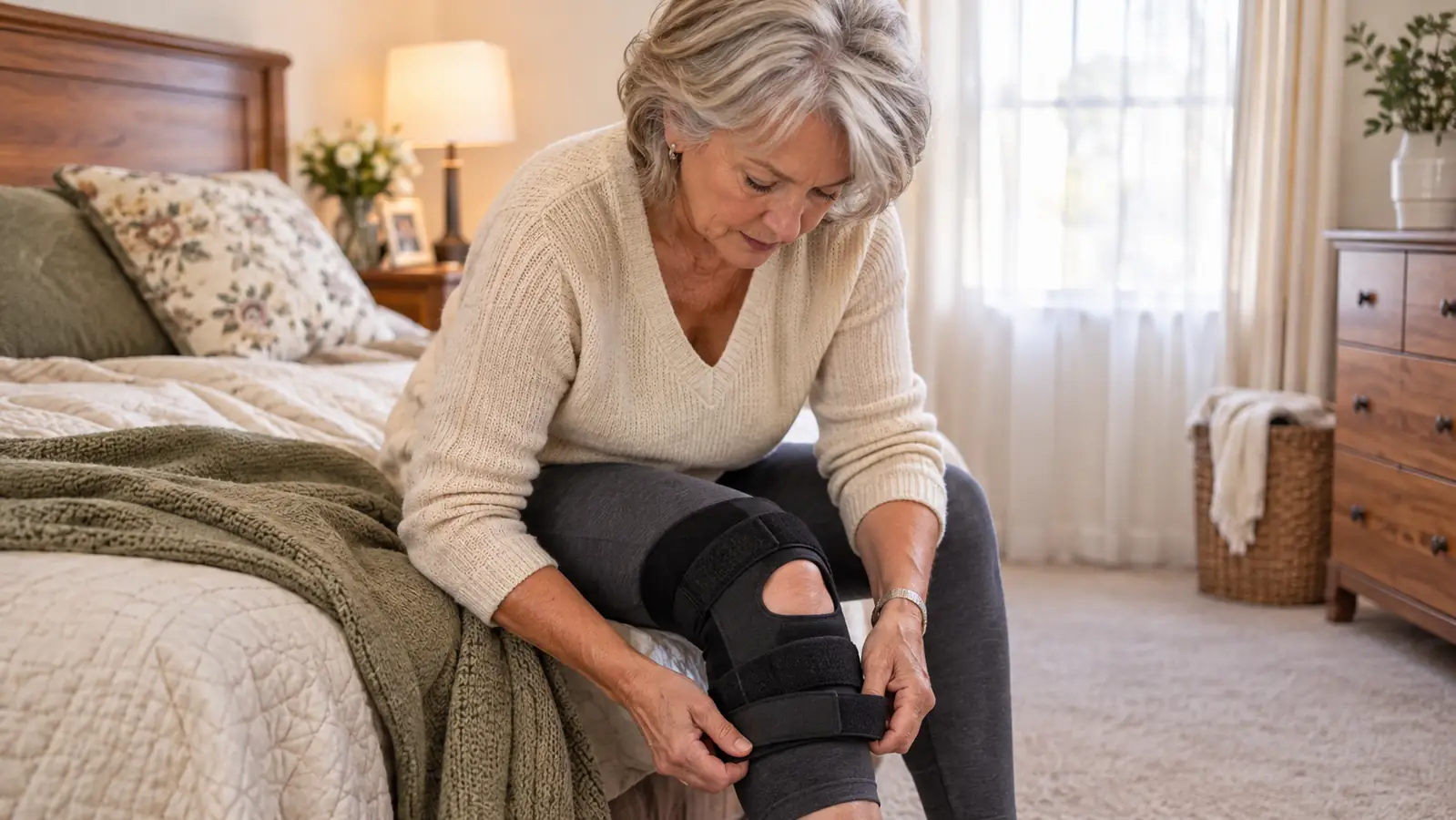
I have worn a brace on my right knee most mornings for about a year and a half, so people ask me which one they should buy. The two names that come up most often are the Bodyprox Knee Brace and the Mueller Knee Stabilizer. Both are sold as support for a knee that aches. Both arrive looking, at a glance, like a piece of stretch fabric with a hole for your kneecap. And both will do something for you, which is exactly why the choice is harder than it looks from the product photos.
Here is the short answer I give. If your knee feels loose or wobbly, or if it wants to wander sideways on stairs, get the Bodyprox. It has springs down both sides and two straps you tighten separately, so you can hold the joint where you want it and loosen it later without taking the thing off. If what you want is light compression and something you can pull on in three seconds without thinking about it, the Mueller sleeve is the better fit. Neither one is a cure for anything. My knee still has arthritis in it. A brace helps me manage an ordinary day, and that is all any brace can honestly promise. Check with your doctor or physical therapist before you start wearing one either way.
| Bodyprox Knee Brace | Mueller Knee Stabilizer | |
|---|---|---|
| How it goes on | A wrap with two hook-and-loop straps you thread, press and adjust | A knit sleeve you pull on like a sock |
| Side support | Springs built into both sides of the brace | No rigid side stays, fabric support only |
| Tightness control | Two straps, adjustable independently, able to wrap any part of the brace | Set by the size you order, nothing to tighten later |
| Getting it on with sore hands | Thread, press, line up the gel pad, repeat | Pull it on and go |
| Profile under pants | More layers and hardware, reads as bulkier | Reads as a slimmer layer |
| Kneecap support | Silicone gel pad at the kneecap | Built-in buttress around the kneecap |
Where Bodyprox Wins
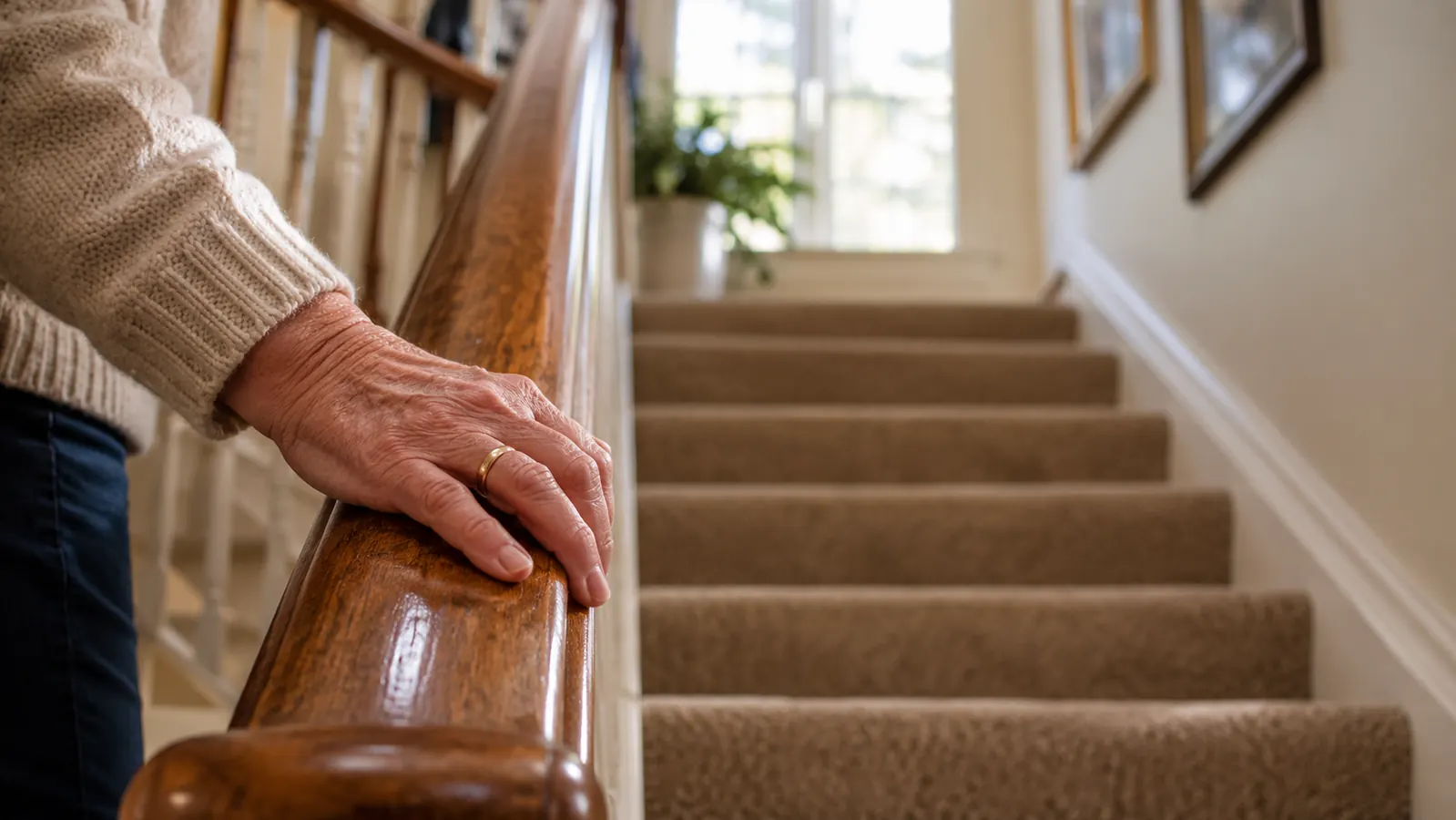
The reason I ended up in a brace at all was the stairs. My house has fourteen carpeted steps up to the bedroom, and for a while every trip up felt like my right knee was considering going a different direction than the rest of me. My physical therapist suggested a stabilized brace rather than a plain sleeve, and that word stabilized is the entire argument for the Bodyprox. The springs along the sides give the joint a firm boundary. They do not stop the knee from bending, which you obviously need on a staircase, but they discourage the sideways drift that makes you grab for the railing. I noticed the difference in the first week. I had been doing the loop with Ruth for months by then, and half of that walk was me watching my feet on the sidewalk joints where the concrete lifts. With the brace on I stopped watching my feet. Not because the knee got better, because it did not, but because it stopped feeling like it was going to slide out from under me. That is a small thing to describe and a large thing to live through.
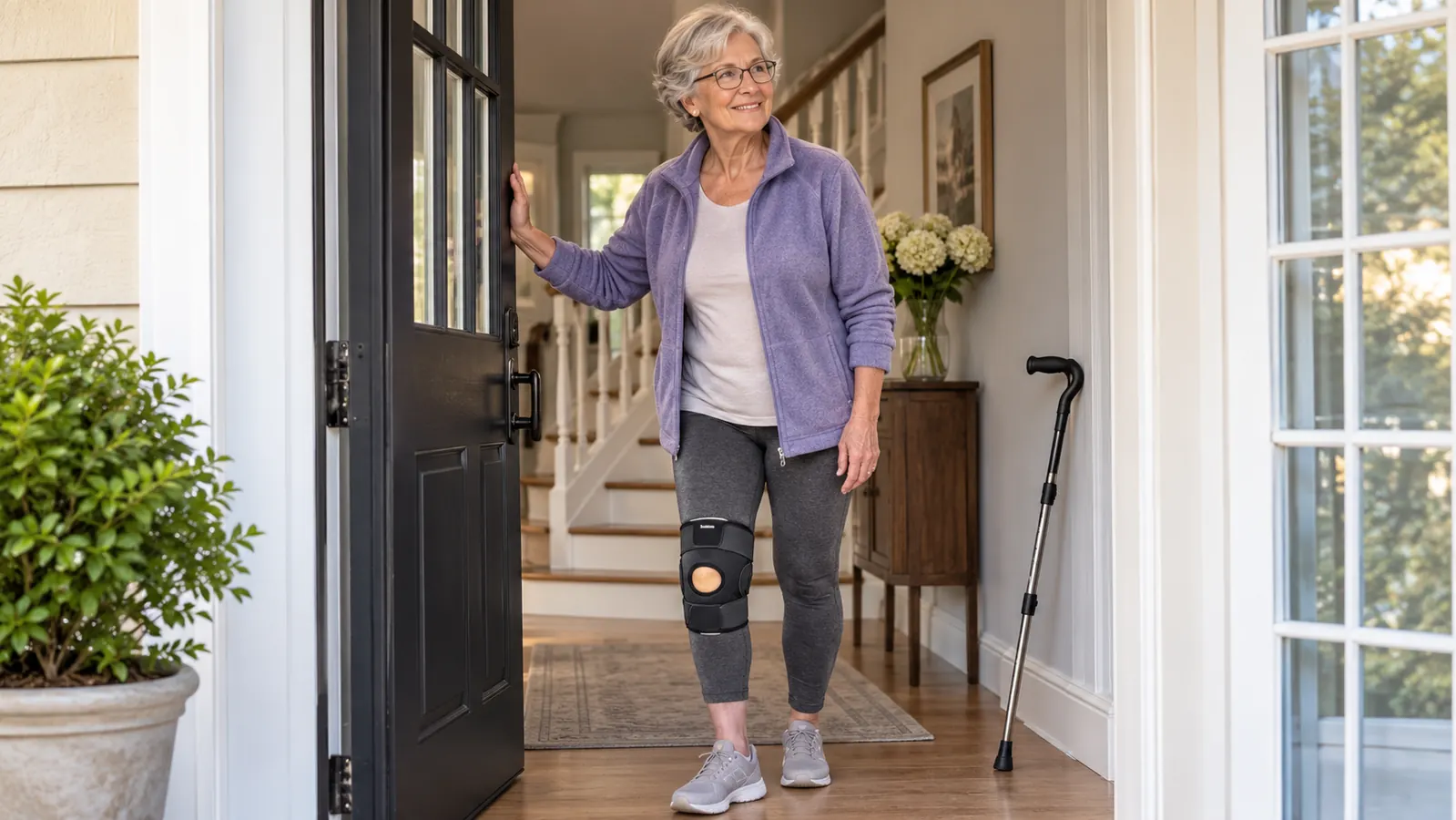
The second thing is the straps. Two of them, hook and loop closure, and you can run them anywhere on the brace and pull each one as snug as you like. In practice that means I put it on tight for the morning walk with my neighbor Ruth and loosen both straps a notch when I sit down at the kitchen table, without taking it off. The gel pad sits over the kneecap, and because the straps are holding it, it stays there. I have walked a mile in it more times than I can count and I have never once had the pad end up somewhere else on my leg. One Tuesday last October I did the loop in a light rain, which I would not have tried the year before. Wet pavement is the test, because that is when you shorten your stride without meaning to and the knee takes the correction. I got home, loosened both straps at the kitchen table, and my knee was tired but not angry. Tired I can work with. Angry costs me two days.
Where Mueller Wins
I have never worn the Mueller Knee Stabilizer, and I want to be straight about that. I read its listing, its size chart and a good number of its written reviews, and I am judging it on paper, not on my own leg. On paper it does two things better than mine. The first is that it is a pull-on sleeve, so it goes on the way a sock goes on. No threading straps, no lining up a pad, no pressing hook and loop into place while balancing on one foot. For a person whose hands are stiff in the morning, that is not a small thing. It is the whole thing.
The second is the profile. A sleeve reads as a slimmer layer under pants than a wrap with two straps and springs in it. Mine is not invisible under jeans, and I have accepted that. If you are wearing it to church or to a family dinner and you would rather nobody noticed, the Mueller shape is the more discreet of the two. It also has nothing to loosen and nothing to readjust in the middle of the grocery store. Some people want exactly that, and I understand why.
If stairs are the part that scares you, this is the brace with the springs
Two side springs, two independently adjustable straps and a gel pad over the kneecap. It is the one I have worn for a mile at a time for a year and a half, over thin leggings, on the bad stair days and the garden days alike.
Amazon Check Today's Price on Amazon →Four sizes, two straps and a gel pad. The part that matters on a staircase is the springs down the sides, and the Mueller sleeve does not have them. That is the whole comparison in one sentence.
What the Sizing Chart Actually Means
The Bodyprox comes in four sizes: XS, one size covering small and medium, large, and extra large. That middle one is what I wear, and it is probably what most people will end up ordering, which is why the size chart matters more than usual here. Measure your knee, not your thigh and not your waist. Measure around the center of the kneecap with the leg straight. If you land between two sizes, the written reviews lean toward going up rather than down, because a brace that is too tight leaves a mark and then you stop wearing it, and a brace in a drawer helps nobody.
The Mueller comes in sized ranges too, and the same advice applies to it. Read the chart, measure the knee, and ignore the small voice in your head telling you that you are probably a medium. Almost everyone believes they are a medium. The brace does not care what you believe. My one real complaint about the Bodyprox is that the sizing is not obvious from the listing photos, so you do have to slow down and use a tape measure before you click.
How I Wear Mine, and When I Take It Off
Mine goes over thin leggings, never against bare skin, and never to bed. I put it on before the morning loop and I take it off when I sit down with coffee and the heating pad. On garden days it stays on until the beds are watered and the tools are back in the shed. On a bad stair day it goes on again after lunch. What I do not do is wear it from morning until night, because my physical therapist was clear that a brace is there to help me keep moving, not to do the moving for me. The garden is where it earns the most, honestly. Two raised beds out back, and getting up and down off a kneeler twenty times in an afternoon is harder on my right knee than the whole mile loop. Last April I set a rule for myself: brace on before I go out, off before I come in. The days I broke that rule and told myself I would only be a minute, I paid for it that evening on the couch with the heating pad and the knee propped on a cushion.
Care is simple and slightly annoying. Hand wash only, according to the listing, and at just under eight ounces mine dries quickly if I press it in a towel first. I wash it about every two weeks, more often in summer. The materials listed are polyester, nylon, a diene type elastic fiber and a little spandex, which is a long way of saying it is a stretch fabric with springs worked into it. Do not put it in the dryer. I learned that lesson on a different stretch item years ago and I am not repeating it.
What the Listing Numbers Tell You
When I looked, the Bodyprox listing carried a rating in the low fours across more than fifty thousand reviews. That is not a product people are passionate about and it is not a product people hate. It is a product a great many people bought, wore, and found fine. The complaints I read most often were about sizing, which tracks with any wrap style brace, and about the straps taking a few tries to get right the first time. The compliments were about the side support and about the brace staying where you put it. The way I read reviews now is to sort by the one-star ones first and see whether the complaint is about the product or about the person. Sizing complaints are about the person, mostly. Strap complaints are about the product. Of the strap complaints I read on the Bodyprox listing, most were written in the first week, which tells me it is a learning curve and not a defect. Nobody writes a review in month six saying the straps are still confusing.
I put less weight on the star averages than on the written complaints, because a star average tells you how people felt and a written complaint tells you why. The why, in both listings, is almost always fit. Neither brace is difficult to use. Both are easy to get wrong at the ordering screen. If you take one thing from this piece, take the tape measure.
Before You Buy Either One
Two things worth saying before you spend anything at all. The first is that a brace is not a diagnosis. If your knee is newly swollen, hot to the touch, or giving way without warning, see your doctor before you shop. I was diagnosed with osteoarthritis in my right knee at fifty-nine. That diagnosis is the reason I knew a brace was a reasonable thing to try, and not a way of avoiding a conversation I needed to have.
The second is that neither brace will fix a weak hip or a stiff ankle, and both of those can make a knee hurt. That is what the six weeks of physical therapy were for, and I still do the home exercises most days. The brace helps me get through the walk. The exercises are what make the walk possible in the first place. Skip that second part and no brace on the market will cover for you, no matter what the box suggests.
Who Should Buy Which
Buy the Bodyprox if your knee feels unstable rather than merely stiff. If you have caught yourself reaching for the railing on the way upstairs, or if your knee has opinions about changing direction on uneven ground, the side springs and the two straps are the reason to pick it. It is also the one to choose if you want to fine tune the tightness during the day without undressing your leg. That is the feature I use most and it is the one thing a sleeve genuinely cannot offer.
Buy the Mueller Knee Stabilizer if you want light compression and a low profile, if your hands struggle with straps and small closures, or if you are buying for occasional use and want something you can put on in a parking lot without a production. It is also the more sensible pick for someone whose knee is mostly stiff in the morning and fine by ten o'clock. That person does not need springs down the sides. That person needs a sleeve and a walk.
The brace I keep by the front door, not in a drawer
Four sizes, hand wash only, just under eight ounces, and two straps you can loosen mid-walk. If your knee wobbles on the stairs, start here, then run the sizing chart past your physical therapist before you order.
Amazon Check Today's Price on Amazon →